Procure-to-Pay Procurement ERP Delivery
ERP workflows for requisitions, supplier RFQs, approvals, purchase orders, and receiving.
Build a procurement backbone that standardises requests, approvals, supplier comparison, and purchasing while making spend control, traceability, and integration-ready workflows.
- Requisition-to-PO: structured requests, approvals, budgets, and PO governance.
- RFQ & supplier comparison: quote collection, scoring, decision trails.
- Receiving & matching: goods receipt, discrepancies, and clean handoffs to inventory/finance.
- Audit evidence: roles, permissions, logs, and change history across the process.
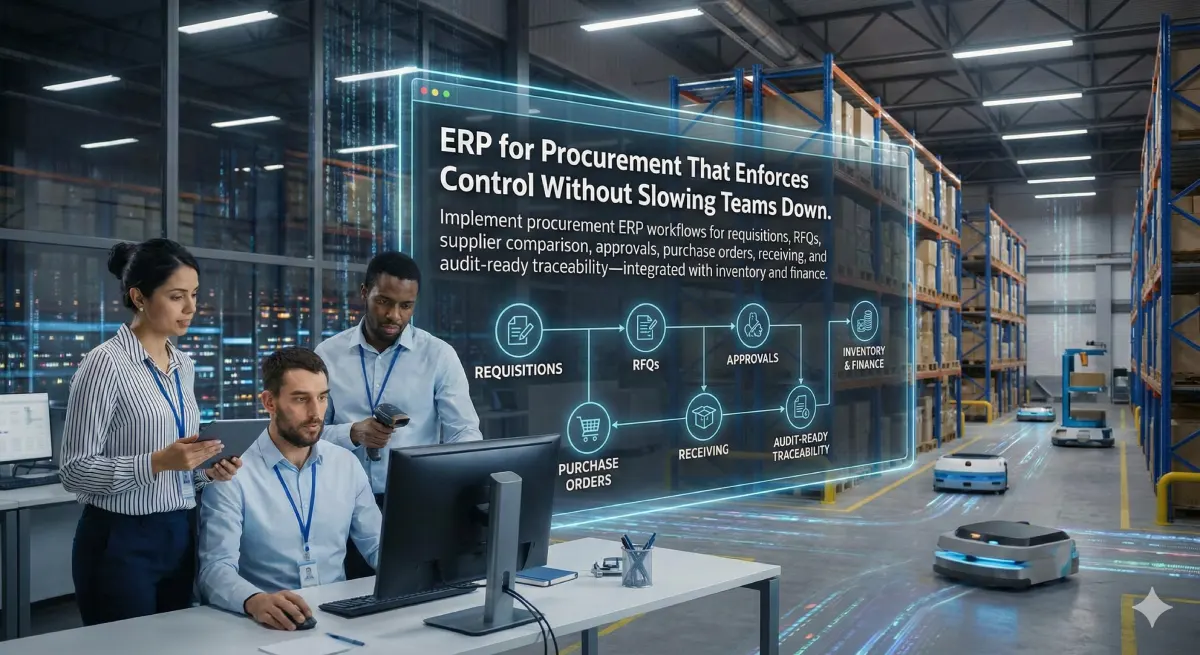
Requisitions
Structured requests.
Approvals
Roles + audit trail.
RFQs
Supplier comparison.
PO governance
Controls and standards.
Integration-ready
Inventory + finance.
Procurement workflows with explicit ownership and decision records
Procurement becomes expensive when approvals are informal, quotes are scattered, and decisions have no trail. A scoped delivery can standardise that cycle while keeping thresholds, exceptions, and delegation rules visible.
Purchase requisitions
Request templates, categories, urgency, justification, and budget signals—so buying starts from structured demand.
Approvals & delegation
Role-based approvals, thresholds, escalation paths, and decision logs—transparent and available for operational and audit review.
RFQ & quote comparison
Collect supplier quotes, compare on price/lead time/terms, and store the rationale for “why this supplier”.
PO, receiving, discrepancies
Standardised POs, receiving records, mismatch handling, and clean handoffs to inventory control and finance.
Operational outcomes to measure after launch
These are evaluation targets, not claimed results. Establish a baseline for approval time, exception rates, supplier comparison coverage, and missing documentation before implementation.
-
Approval cycle time
Measure waiting time, reassignment, escalation, and accountable ownership by request type.
-
Supplier comparison coverage
Track whether comparable quotes, terms, and selection reasons are recorded for purchases that require them.
-
Exception and bypass rate
Track off-process purchases, missing documents, threshold overrides, and their approved reasons.
-
Decision traceability
Verify that the actor, decision, timestamp, terms, and related records are retained.
Delivery Package
A defined procurement delivery package.
A scoped delivery can include documented workflows, controls, and integration touchpoints. The signed scope and acceptance criteria determine the final package.
Process design: requisitions, approvals, RFQs, POs, receiving
Supplier layer: quote comparison, terms, performance indicators
Controls: thresholds, delegation, audit trail, structured logs
Documentation: onboarding notes + handover checklist
Not sure which procurement bottleneck to fix first?
The fixed-scope Integration Reliability Review documents current risks and a prioritized action plan for approvals, supplier comparison, and integrations.
Direct technical contact • Scope before estimate • No guaranteed operational outcome
Procurement ERP FAQ
Short, decision-grade answers focused on delivery and governance.
Can this integrate with inventory control?
Yes. Receiving and discrepancy records can feed inventory movements through an agreed contract. Stock accuracy still depends on source data, controls, and operational use.
Do you support RFQ workflows and supplier comparison?
Yes. RFQ intake, quote collection, comparison views, and decision logs can be included. Their effect on risk or supplier outcomes must be measured in your process.
How do approvals stay fast and not bureaucratic?
Approvals can use thresholds, delegation rules, and exception handling so routine and exceptional paths remain distinct. Actual approval time depends on role ownership and response behaviour.
What is the first milestone you recommend?
Start with requisitions + approvals + RFQ + PO governance, then expand to receiving automation, supplier KPIs, and deeper finance matching.