B2B Wholesale CRM Delivery
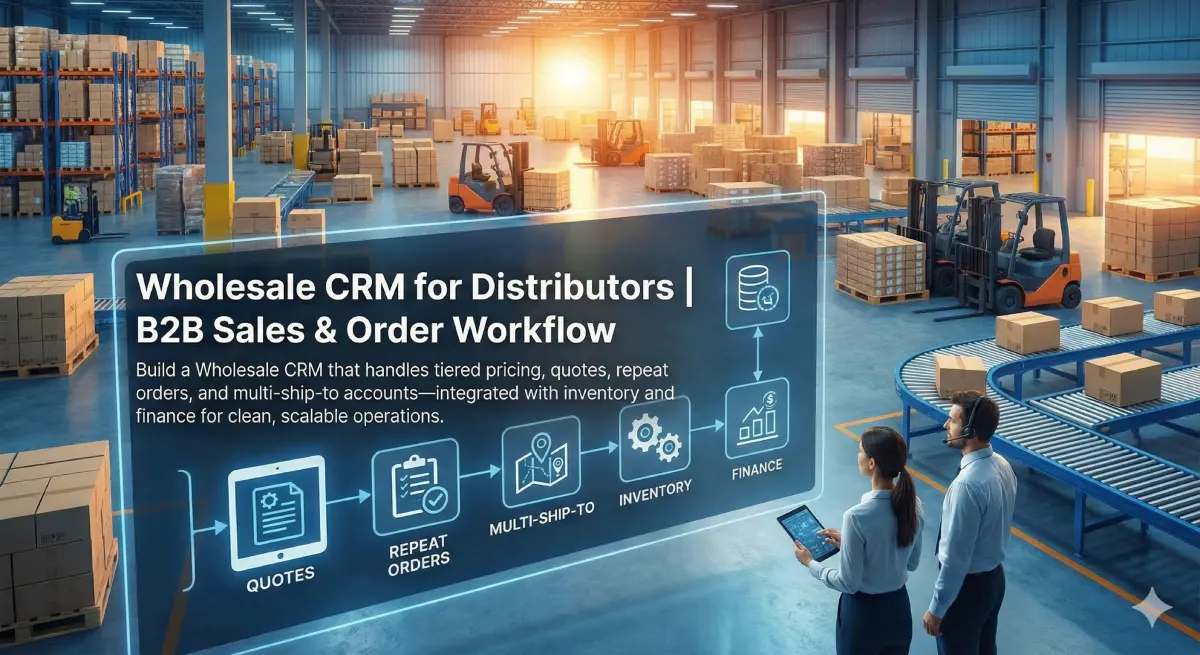
Custom Wholesale CRM for distributors, pricing teams, and repeat B2B orders.
A scoped wholesale CRM can consolidate tiered pricing, repeat orders, account terms, and operational handoffs. The implementation boundary is defined against your existing inventory, finance, and order systems before an estimate is made.
- Tiered pricing & discounts: customer groups, price lists, volume rules.
- Quote-to-order workflow: versioned quotes, approvals, defined handoffs.
- Account-grade CRM: multi-ship-to, terms, credit limits, order history.
- Integration-first: sync inventory signals, invoicing, and fulfilment status.
Complex pricing
Tiered discounts & price lists.
Quote-to-order
Approvals & clean handoffs.
Order visibility
Status, fulfilment, returns.
Integrations
ERP, accounting, inventory.
Governance
Roles, audit trail, logs.
Why Wholesale CRM Can’t Be “Just a Sales CRM”
Wholesale operations run on pricing rules, repeat orders, and fulfilment constraints. A generic CRM tracks leads; a Wholesale CRM aligns the full commercial workflow—from account terms to delivery.
Pricing & terms at account level
Represent customer groups, price lists, payment terms, credit limits, and multi-ship-to logic in one explicit account model.
Repeat ordering from approved history
Use historical orders as the source for a reviewed re-order while retaining commercial context and account ownership.
Order status & fulfilment visibility
Give teams and customers clarity with order status, delivery milestones, exceptions, and communication history.
Design pattern for manufacturing and wholesale CRM
For manufacturing and wholesale CRM work, structured pricing, explicit quote-to-order states, and defined integration ownership form a useful baseline. Operational improvements are targets to measure against the current process, not outcomes assumed before delivery.
Wholesale CRM Capabilities
Modular delivery can start with the workflow that has the clearest ownership or data problem, then expand through documented interfaces.
Pricing rules your team can trust.
Customer groups, tiered discounts, price lists, terms, credit limits, and ship-to profiles with explicit rule precedence and record ownership.
- Tiered pricing & volume breaks
- Multi-ship-to + account terms
Governed quote-to-order states.
Standardise quoting, approvals, and conversion to orders—so sales and ops share one consistent workflow.
- Approvals, notes, and audit trail
- Repeat orders from history
Inventory signals + fulfilment clarity.
Surface sourced inventory, invoice, and delivery states in the CRM with freshness and ownership rules for each field.
- Stock availability & lead times
- Structured logging & traceability
Map the integration risk before a Wholesale CRM build
The Integration Reliability Review documents current ownership, failure modes, and a prioritized action plan. It does not promise a commercial result.
Wholesale CRM FAQ
Short, decision-grade answers—focused on delivery, risk, and operational fit.
Do I need to replace my ERP to use a Wholesale CRM?
Not necessarily. A Wholesale CRM can sit cleanly beside your ERP—handling pricing, accounts, quoting, and sales workflows, while syncing key data points (stock signals, invoicing status, customer terms) via integration.
Can you handle tiered pricing and customer-specific discounts?
Yes—this is the core difference between generic CRMs and wholesale-grade systems. The model supports price lists, volume breaks, customer groups, and approval rules when exceptions are needed.
What about repeat orders and multi-ship-to accounts?
Repeat ordering can use a previous order as a reviewed starting point, while the account model retains multiple ship-to locations, terms, and contacts under explicit identifiers.
How do you protect data and enforce governance?
Role-based access, permissions, audit events, and structured logging are included in the design and acceptance criteria. The exact controls depend on the data classification and roles agreed during discovery.