Operations Inventory Control Delivery
Inventory control for movements, reservations, reordering, and traceability.
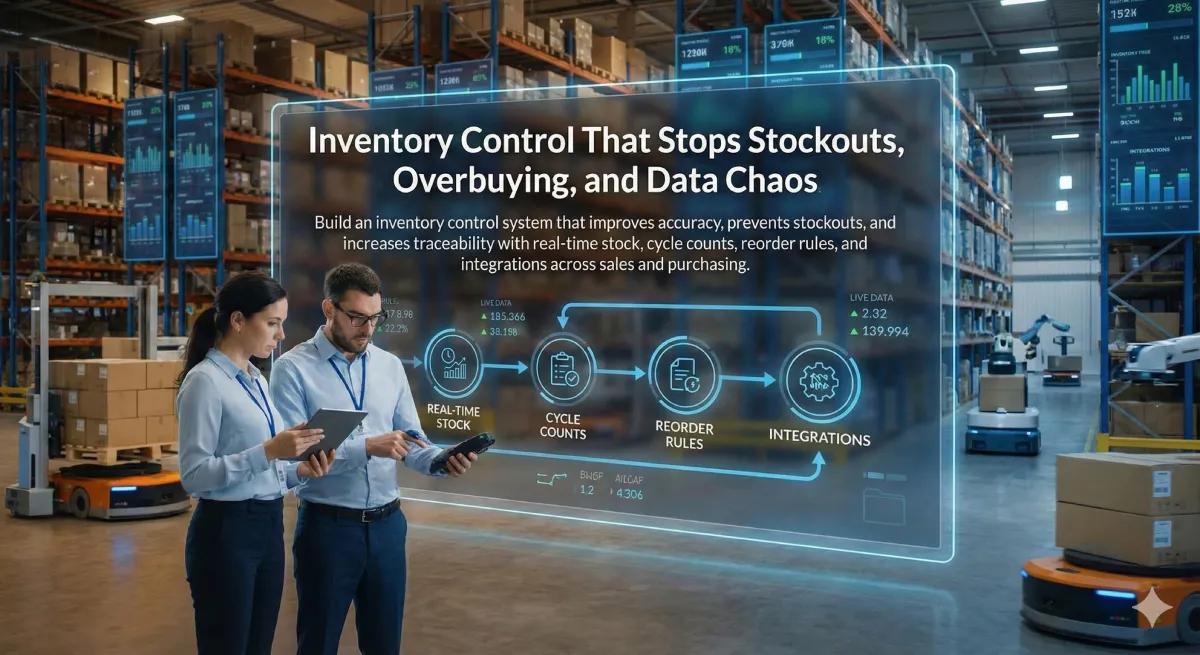
A scoped inventory control system can define how stock is received, moved, reserved, counted, and handed between sales, purchasing, and fulfilment. Accuracy targets require a baseline and operating controls.
- Stock ledger: movements, reservations, and availability rules.
- Traceability & control: batches/lots, locations, adjustments, and audit trail.
- Reorder intelligence: min/max, lead times, safety stock, and exception alerts.
- Integration-ready: connects cleanly with sales, procurement, and finance.
Location control
Bins, zones, and movements.
Scanning-ready
Scan-assisted receiving & picking.
Lot & batch traceability
Controlled adjustments.
Reorder signals
Reorder rules & alerts.
Governance
Roles + audit trail.
Inventory workflows with explicit stock states and controls
Busy operations expose missing ownership and inconsistent stock rules. This delivery focuses on controlled movements, receiving and picking states, and an agreed definition of what “available” means.
Receiving & put-away
Structured receiving, QC status, location assignment, and discrepancy handling with explicit exception records.
Stock movements & adjustments
Internal transfers, consumption, write-offs, and reasons—tracked with a full audit trail and role control.
Reservations & allocations
Represent reservations for quotes and orders with configurable allocation and release rules.
Cycle counting
Rolling counts by zone/category, variance reports, approvals, and controlled corrections.
Operational outcomes to measure after launch
These are evaluation targets, not claimed results. Record a baseline for count variance, stockouts, rush orders, failed picks, and undocumented adjustments before implementation.
-
Stock variance
Compare counted quantities with ledger quantities by location, item, and reason.
-
Stockout and rush-order frequency
Measure exceptions after reorder rules are configured from lead-time and demand assumptions.
-
Fulfilment exceptions
Track failed picks, reservation conflicts, substitutions, and manual corrections.
-
Stock-event traceability
Verify that actor, item, quantity, location, timestamp, and reason are retained for critical events.
Delivery Package
A defined inventory control delivery package.
A scoped delivery can include documented flows, controls, and an integration plan. The signed scope and acceptance criteria determine the final package.
Process mapping: receiving, movements, counting, reservations
Governance: roles, approvals, audit trail, structured logs
Integration plan: sales, purchasing, finance touchpoints
Documentation: onboarding notes + handover checklist
Not sure what’s causing inventory drift?
The fixed-scope Integration Reliability Review documents current risks and a prioritized action plan for controls and integrations.
Direct technical contact • Scope before estimate • No guaranteed operational outcome
Inventory Control FAQ
Decision-grade answers focused on operational fit and delivery risk.
Can this work alongside my current accounting or ERP?
Yes. Inventory control can be scoped as an operational layer with defined stock and document interfaces. Whether the existing ERP remains authoritative is decided from its data model and integration options.
How do you prevent silent stock changes?
Movement and adjustment workflows can require roles, approvals, reason codes, and audit events. Access and retention rules are agreed in the scope.
Do you support cycle counting and variance reporting?
Yes. A scope can include rolling counts by zone or category, variance views, approvals, and controlled correction flows.
What’s a realistic first milestone?
A practical baseline is receiving + movements + availability rules + a basic reorder model—then expand into scanning, traceability, and advanced allocations.