If you would like to receive a quote for your project or discuss long-term or short-term business opportunities with me, Schedule an Appointment now.

On-time
Tech
Support
Manufacturing & Wholesale CRM

A Manufacturing CRM built for RFQs, quoting, approvals, and real operations.

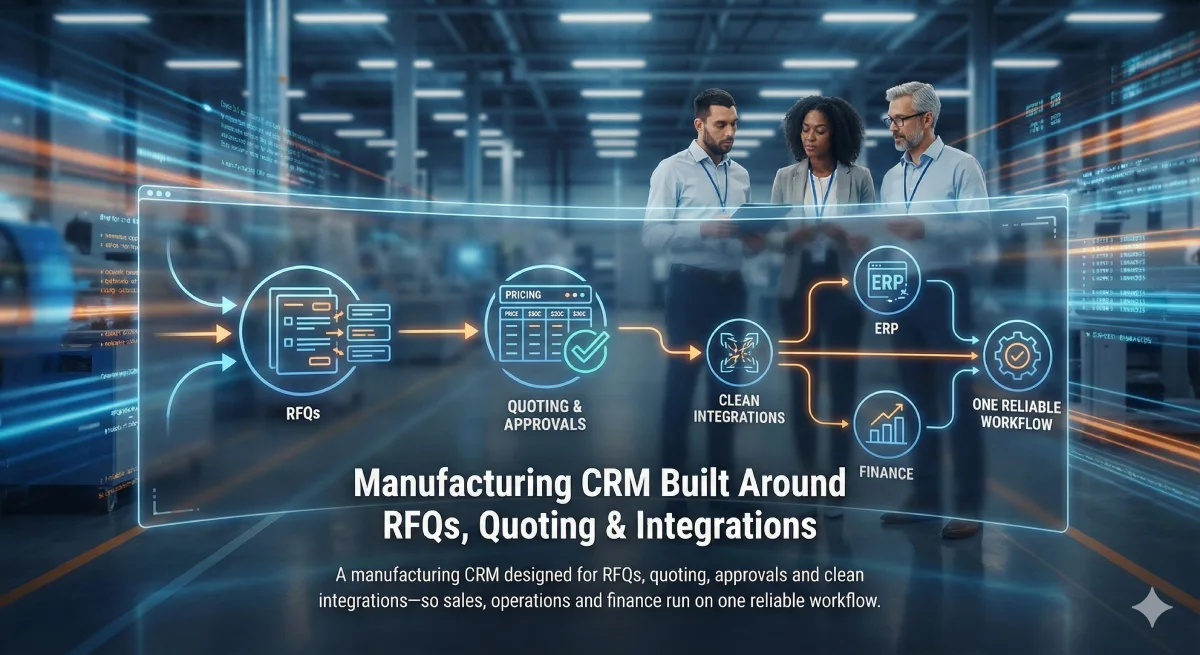
Manufacturing sales cycles aren’t “one-call closes.” You manage specifications, pricing logic, approvals, delivery constraints, and ongoing account history. This CRM is designed to support the full workflow—so your team can move from RFQ → quote → order → invoice with clarity and control.

  • Workflow-first structure that mirrors your shop reality—not generic templates.
  • Integration-ready APIs for ERP, accounting, inventory, and external tools.
  • Audit-friendly approvals, change history, roles, and traceable activity.
Response within 24 hours Clear scope & timeline Documentation included
Manufacturing CRM dashboard concept with RFQ, quoting and approvals

Why Manufacturing & Wholesale CRM Needs a Different Playbook

A Manufacturing & Wholesale CRM is not a “generic sales tracker”. In manufacturing and distribution, your pipeline is shaped by RFQs, price revisions, lead times, multi-contact accounts, approvals, and operational handoffs. The CRM must connect quoting to delivery signals—without creating duplicate data or breaking accountability across teams.

RFQ-driven sales

Structured RFQ intake, fast quote iterations, and clean version history.

Operational handoffs

Quote → order → fulfilment visibility with fewer manual touchpoints.

Auditability

Approvals, change logs, and role-based access by design.

If you want, I can map your RFQ-to-cash workflow and propose a CRM blueprint aligned to your operations.

The RFQ-to-Quote Workflow Your Team Can Execute Consistently

Manufacturing CRM should remove ambiguity: who owns the next step, what changed, and what is ready for handoff. This is how we structure the workflow to keep quoting fast, controlled, and scalable.

  1. RFQ intake & qualification

    Capture requirements, documents, and stakeholders. Standardise fields so quoting is not tribal knowledge.

  2. Quoting with version control

    Quote revisions, pricing rationale, and margin guardrails—so the latest version is always unambiguous.

  3. Approvals & audit trail

    Automated approvals by thresholds (discount, margin, credit). Every approval and change is logged.

  4. Order handoff & ERP alignment

    Clean handoff to ERP/ops: customer, items, terms, lead times. No re-typing. No duplicate sources of truth.

  5. Visibility & reporting

    Track conversion, quote cycle time, reasons for loss, and handoff bottlenecks—so improvements are measurable.

Selected Work Built for Real Operations

Practical systems, built around workflow ownership and operational clarity—not vanity features.

Manufacturing ERP Platform

Factory ERP with traceable workflows

Built an operations-first ERP foundation focused on process ownership, auditability, and clean data flow across teams.

Approvals Audit Trail Inventory Integrations
View overview

Hospitality Ops System

Cafe / restaurant order tracking

Built an operational order flow that improves handoffs and reduces missed steps during peak hours.

Workflow Roles Reporting
View overview

Asset / Stud Management

Stud management operations

Built a management system that focuses on operational visibility, structured records, and consistent workflows.

Records Traceability Permissions
View overview

Manufacturing CRM FAQs

Straight answers to the questions that matter when you’re replacing spreadsheets or a generic CRM.

Can a Manufacturing CRM support RFQs and quote approvals?
Yes—this is a core requirement. The workflow should include RFQ intake fields, pricing checkpoints, approval rules, and versioned quote history so you can enforce governance without slowing delivery.
Do I need to replace my ERP to implement a CRM?
Not necessarily. In many cases, the best approach is a CRM that integrates cleanly with your ERP—so customer ops is structured, while the ERP remains the operational backbone for inventory, fulfilment, and finance.
What should be integrated first?
Start with the objects that cause the most duplication: accounts/contacts, products or part master references, quote/order status, and a reliable activity timeline. Then add deeper operational integrations.
How do you handle permissions and traceability?
Role-based access, approval gates, and a clear change history (who/what/when) are built into the delivery approach, especially for quoting and account-critical flows.

Ready to Reduce Quoting Chaos and Build a CRM Your Team Trusts?

If you share your current RFQ, quoting, and handoff flow, I’ll propose a practical CRM blueprint: ownership, integrations, and a rollout plan your operations can execute.

Typical response time: within 24 hours • Clear scope & timeline • Documentation included