If you would like to receive a quote for your project or discuss long-term or short-term business opportunities with me, Schedule an Appointment now.

On-time
Tech
Support
By Tuğrul Yıldırım

Integration Observability for CRM/ERP | Logs, Traces, Correlation IDs

Integration Observability for CRM/ERP

How to make integrations debuggable: correlation IDs, structured logs, metrics, tracing, alerting, and SLOs—so failures don’t become “silent revenue leaks.”
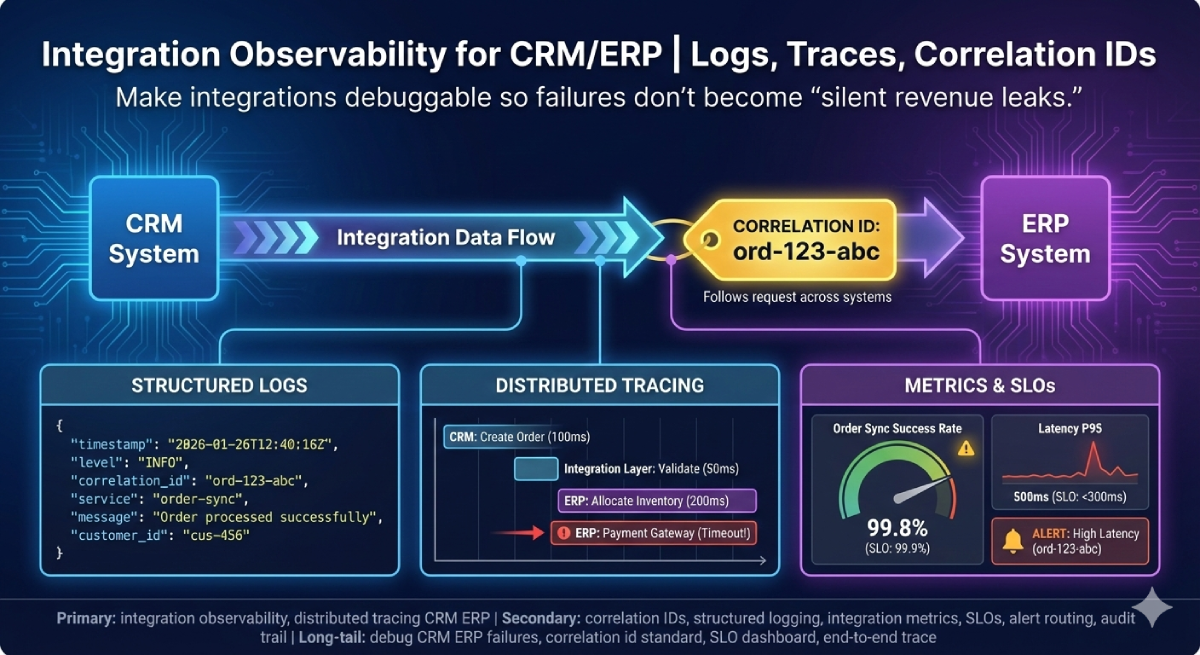
Integration Observability for CRM/ERP | Logs, Traces, Correlation IDs

Executive brief

Most CRM↔ERP integrations don’t “go down”—they fail silently. One missing webhook, one stuck queue, one mis-mapped status code can become a silent revenue leak: wrong prices, stale inventory, missing order updates, delayed invoices. Integration observability turns that risk into a managed operating model using correlation IDs, structured logs, distributed tracing, metrics, alerting, and SLOs.

Implementation standards for signing, idempotency, and contract discipline: /api-integrations. If you want a system-level review of your integration layer and production readiness: /architecture-review.

Why integrations fail silently: the hidden tax of “it usually works”

If your integration layer is missing end-to-end traceability, “success” becomes a guess. Teams find out about failures from customers, not dashboards. The most expensive failures are not 500s— they are incorrect business outcomes: wrong price, stale availability, missing order updates, delayed credit notes.

Silent failure

Lost events

Webhook gaps, CDC consumer lag, polling cursor drift—no alarm until data drift becomes customer impact.

Revenue risk

Silent failure

Retries without idempotency

Duplicate updates look like “system noise” until you see double reservations, double stock movements, or inconsistent balances.

Ops drain

Silent failure

Unknown blast radius

Without correlation IDs + tracing, you cannot answer: “Which customers? Which orders? Which connectors?”

Slow MTTR

Executive rule: if you cannot trace a single order from CRM → queue → ERP → invoice with one identifier, you don’t have observability—you have logs.

Observability stack for integrations: logs, traces, metrics—and governance

Integration observability is not a tool choice. It’s a standard you enforce across connectors, queues, workers, and ERP/CRM adapters. The practical stack is a 3-layer model with a governance layer on top.

Layer What it answers Minimum standard
Structured logs What happened? JSON schema, stable error codes, correlation fields
Distributed tracing Where did it break? Span model, trace propagation, semantic attributes
Metrics & SLOs Is the system healthy? Latency SLIs, error rates, backlog/lag, error budgets
Governance Is it enforceable? Contract discipline, release gates, runbooks

Practical takeaway: start with standards (correlation IDs + structured logs), then add traces for speed, then define SLOs to prevent “dashboard theater.” Use /api-integrations as your baseline governance hub.

Correlation ID standard: the single lever that upgrades your whole integration layer

Correlation IDs connect CRM actions, queues, ERP API calls, and database writes into one narrative. Without a standard, every team invents their own “request id,” and incident response becomes archaeology.

Minimum propagation rules

  • Accept inbound IDs from trusted sources; otherwise generate at the edge.
  • Propagate via headers, message metadata, and job payloads.
  • Persist on domain entities (order/invoice/sync job) for audit & replay.
  • Never drop the ID across async boundaries (queue, scheduler, retry, DLQ).
X-Correlation-Id X-Request-Id traceparent

Recommended ID format

Keep it machine-friendly. Don’t encode PII. Ensure uniqueness and high cardinality.

Example

corr_01HRVQ8QX8K6YB2T9M2WZ2FQ3K

Persist alongside: tenant_id, connector, entity_type, entity_id, attempt.

If you adopt one standard this quarter: adopt correlation IDs everywhere. It is the fastest path to lower MTTR and credible “distributed tracing CRM ERP” capabilities—without rewriting your whole platform.

Structured logging schema: turn “log noise” into searchable evidence

Unstructured logs don’t scale. The fix is not “more logs”—it’s a stable schema with governance: consistent fields, stable error codes, and predictable levels. Your schema becomes an operating contract.

Field Type Why it matters
timestampISO8601Ordering + incident timelines
levelenumAlert routing + noise control
correlation_idstringEnd-to-end traceability
tenant_idstring/intBlast radius + isolation
connectorstringWhich integration path?
entity_type / entity_idstringOrder/Invoice/Product targeting
event_namestringBusiness-aligned reasoning
error_codestringStable triage + automation
attemptintRetry visibility + idempotency
duration_msintLatency SLI inputs

Example JSON log (copy/paste baseline)

{
  "timestamp": "2026-01-26T10:24:18.442Z",
  "level": "ERROR",
  "service": "integration-worker",
  "environment": "production",
  "correlation_id": "corr_01HRVQ8QX8K6YB2T9M2WZ2FQ3K",
  "tenant_id": "acme_eu_01",
  "connector": "crm_to_erp.order_sync",
  "entity_type": "order",
  "entity_id": "SO-104928",
  "event_name": "order.status.updated",
  "attempt": 3,
  "duration_ms": 842,
  "error_code": "ERP_TIMEOUT",
  "http": { "method": "POST", "status": 504, "route": "/erp/orders/status" },
  "message": "ERP API timeout during status update",
  "tags": ["slo:latency", "dlq:candidate"],
  "trace_id": "4bf92f3577b34da6a3ce929d0e0e4736",
  "span_id": "00f067aa0ba902b7"
}

Pair this with versioned contracts and error standards from /api-integrations.

Tracing (spans): the blueprint for distributed tracing across CRM, queues, and ERP

Traces answer the question logs cannot: where time was spent and where the chain broke. A practical “distributed tracing CRM ERP” model defines spans around boundaries: ingress, enqueue, worker, outbound calls, and commits.

  1. ingress.webhook (or ingress.api): validate signature + parse payload
  2. queue.publish: enqueue job with correlation metadata
  3. worker.consume: start processing + lock/idempotency check
  4. transform.mapping: apply mapping + contract validation
  5. erp.api.request: outbound call with trace headers
  6. db.commit: persist state, audit trail, checkpoints
  7. notification.callback: publish downstream event / update CRM

Each span should include attributes: correlation_id, tenant_id, connector, entity_id, attempt, and error_code.

Metrics & SLOs: turn observability into an operating contract

Metrics become strategic when they map to outcomes. For integrations, your SLOs should protect: freshness (latency), correctness (reconciliation mismatch), and recoverability (DLQ age).

SLI Definition Suggested SLO (baseline)
End-to-end latency t(change detected) → t(target committed) p95 < 5 min
Error rate Failed attempts / total attempts (by connector) < 0.5%
Backlog / consumer lag Queue depth or CDC lag (seconds/minutes) alert at 10 min
DLQ age Oldest message age in dead-letter queue 0 > 30 min
Reconciliation mismatch Mismatch rate between source and target snapshots < 0.1%

Governance move: define error budgets per connector. If a connector burns the budget, feature work pauses and reliability work becomes the priority—this prevents “fragile scale.”

Alert routing: route to the right team with the right context

Alerting fails when every signal pages everyone. Route by blast radius, business criticality, and ownership. The goal is fewer pages—but higher confidence when pages happen.

  • Triggers: DLQ age breached, reconciliation mismatch spike, inventory freshness SLO breached.
  • Routing: on-call integration owner + business stakeholder channel.
  • Payload: correlation_id samples, affected tenants, connector name, top error codes, rollback option.

Incident playbook: reduce MTTR with a repeatable workflow

Your incident response must be a product: the same steps, the same dashboards, the same outputs. This playbook assumes correlation IDs, structured logs, tracing, and SLO dashboards already exist.

  1. 1

    Confirm impact

    Which connectors, which tenants, which entities? Pull 5 sample correlation IDs.

  2. 2

    Locate the break

    Trace the path: ingress → queue → worker → ERP API → commit. Identify dominant error codes.

  3. 3

    Stabilize

    Throttle, circuit-break outbound calls, isolate tenants, or switch to fallback mode.

  4. 4

    Recover correctness

    Replay DLQ, run scoped backfill, and validate reconciliation mismatch returns to baseline.

Want this as a production operating model?

I implement correlation standards, logging schemas, trace maps, SLO dashboards, and incident runbooks for CRM/ERP integration layers— so failures become measurable, actionable, and recoverable.

Auditability: prove what happened, when, and why—without exposing sensitive data

Auditability is observability’s enterprise cousin: it’s not about debugging only— it’s about governance, compliance, and dispute resolution (pricing, invoicing, credits, shipment timelines).

Audit trail minimums

  • Immutable record of state transitions (before/after or event payload hash).
  • Correlation ID stored on business entities (order/invoice/return).
  • Actor + source system + connector + timestamps + attempt counters.
  • Retention policy aligned with business/legal requirements.

Security & privacy guardrails

  • Never log full PII; mask or hash sensitive fields.
  • RBAC for dashboards and logs; tenant isolation by design.
  • Separate operational logs from audit logs (different access policies).
  • Standardized error payloads (stable codes, no sensitive leakage).

More integration playbooks

Explore additional CRM/ERP integration patterns and governance guides in the blog index.

Browse all posts

Share this article

Related Articles

Continue reading with these related articles on CRM, ERP, and API integrations.

Need help implementing these insights?

Get a practical scope direction and integration roadmap for your CRM, ERP, or API project.

Typical response within 24 hours · Clear scope & timeline · Documentation included