If you would like to receive a quote for your project or discuss long-term or short-term business opportunities with me, Schedule an Appointment now.

On-time
Tech
Support
By Tuğrul Yıldırım

Change Data Capture for CRM–ERP Integrations | CDC vs Webhooks vs Polling

Change Data Capture for CRM–ERP Integrations

A practical blueprint to choose CDC, webhooks, or polling for CRM–ERP sync—latency, reliability, data correctness, and operational cost trade-offs.

Change Data Capture for CRM–ERP Integrations | CDC vs Webhooks vs Polling

Executive brief

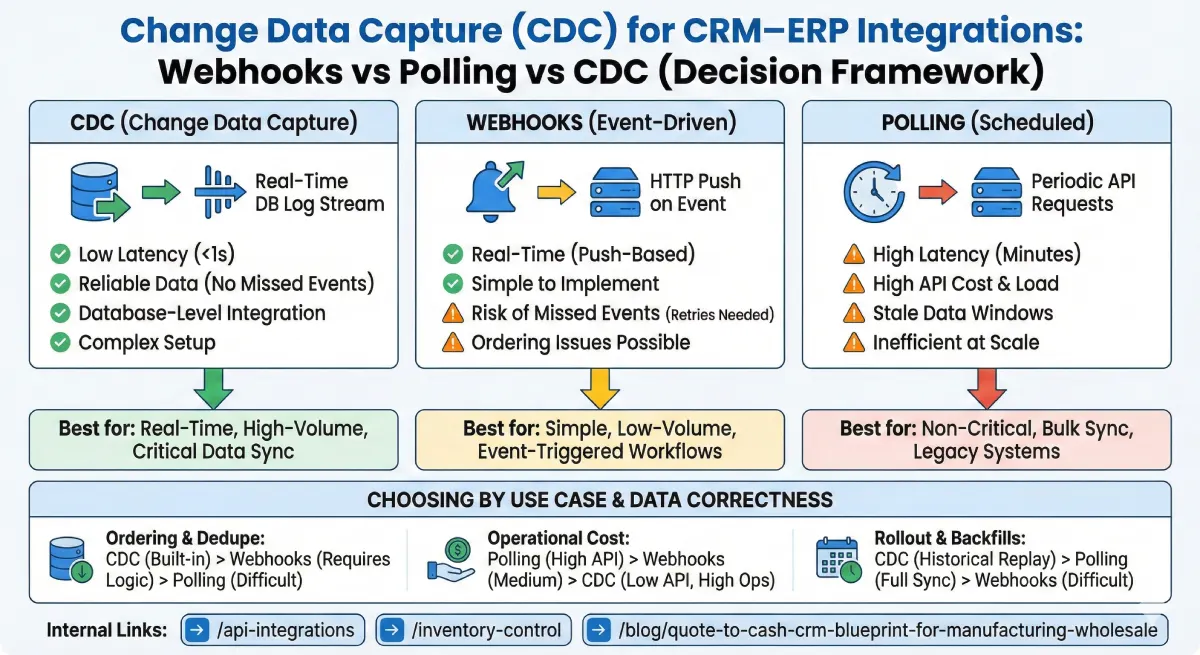
CRM↔ERP synchronization doesn’t fail because “the API was down.” It fails because the integration layer can’t guarantee four enterprise-grade properties: no silent gaps, safe retries, correct ordering, and operational recovery. This decision framework compares change data capture ERP integration patterns with CDC vs webhooks and polling—so you choose the right mechanism per domain (inventory, pricing, orders) without paying hidden operational tax.

  • CDC for durable capture + replay/backfills when correctness is non-negotiable.
  • Webhooks for fast time-to-value, but only with idempotency, queues, DLQ, and reconciliation.
  • Polling for constrained systems, with incremental cursors, overlap windows, and disciplined backoffs.

Align implementation standards with /api-integrations (signing, idempotency, contract discipline), and validate inventory-critical correctness against /inventory-control. For end-to-end commercial impact, connect this to the Quote-to-Cash blueprint.
When CRM–ERP sync fails: it’s not “technical”—it’s revenue, trust, and ops efficiency

Production failures rarely look like a single outage. They show up as pricing disputes, inventory mismatches, incorrect order status, and missing credits/adjustments. The root cause is almost always the same: you don’t have a reliable “change capture + recovery” mechanism aligned with business-critical domains.

Failure mode

Silent gaps

A change never arrives (or never gets applied). Nobody notices until drift triggers financial or customer-impacting incidents.

Highest cost

Failure mode

Duplicates

Retries reapply the same update (double orders, double inventory movements, inconsistent balances).

Common

Failure mode

Wrong ordering

State transitions apply out of sequence (a “cancel” lands before “confirm”), producing incorrect “current truth.”

Sneaky

Enterprise rule of thumb: if the domain touches inventory, pricing, orders, fulfillment, invoices, correctness should lead. CDC often wins because it gives you replay/backfills and measurable recovery.

CDC basics: what “Change Data Capture” actually guarantees (and what it doesn’t)

CDC captures changes at the database layer, not just at the app/API layer. That makes it attractive for durable change capture, replay, and backfills. In practice, CDC is a reliability tool: it reduces the risk that a change “never existed” for downstream systems.

CDC capability What you gain Why CRM–ERP teams care
Replay Reprocess historical changes Fix drift without full table reloads
Incremental stream Only move what changed Lower load + predictable latency
Operational backfills Controlled rebuild by range/scope Safer migrations and incident recovery

CDC isn’t “set and forget.” You still need schema-change discipline, permissions, data masking rules, and consumer correctness controls. The difference is: CDC gives you a stronger recovery lever when the inevitable happens.

Webhooks pitfalls: why at-least-once delivery demands enterprise guardrails

Webhooks are the fastest path to near-real-time sync—until production reality hits. Most webhook systems deliver events at least once. That means duplicates are normal, not exceptional. Gaps happen too (timeouts, subscriber outages, provider limits, misconfigurations, schema changes). Without idempotency, queues, DLQs, and reconciliation, “webhook-based sync” turns into “support-based sync.”

  • Signed webhooks + timestamp validation
  • Idempotency keys (event_id / delivery_id) with persistence
  • Queue-backed processing (thin handler, robust worker)
  • Retry policy + DLQ + replay runbook
  • Contract versioning + deterministic error standards

Standards reference: /api-integrations

Polling at scale: simple to start, expensive to operate

Polling is sometimes unavoidable. But once volumes grow, polling becomes a cost center: higher API spend, throttling fights, and correctness complexity (incremental cursors, overlap windows, racing updates). Polling is acceptable when you build it like a product—measured, rate-limited, and reconciled.

What makes polling production-grade

  • Incremental cursor (updated_at + stable tie-breaker) + overlap window
  • Adaptive backoff + rate-limit aware scheduling
  • Partitioning by customer/tenant/segment for predictable load
  • Periodic reconciliation + scoped backfills

Where polling is a bad default

  • Inventory/ATP where customers expect near-real-time correctness
  • High-frequency order status and shipment updates
  • APIs with inconsistent filtering/pagination semantics
  • Sources without reliable incremental timestamps

Choosing by use case: the decision matrix (latency, correctness, cost, governance)

Don’t pick one mechanism for everything. Enterprises win with a domain-first selection and a hybrid model. Use this as a pragmatic baseline for CDC vs webhooks decisions.

Use case Latency Correctness Best fit
Inventory / ATP availability Near real-time Very high CDC Hybrid
Contract pricing updates Minutes High (audit/replay) CDC Webhooks + backfill
CRM account/contact updates Minutes–hours Medium Webhooks Polling (low volume)
Order lifecycle/status Near real-time High (timeline integrity) CDC Webhooks + reconciliation

In real deployments, hybrid wins: CDC for durable truth, webhooks for instant triggers, polling as a controlled fallback. The differentiator is governance + operational discipline, not “which tool is trending.”

Data correctness: ordering, dedupe, idempotency—and drift insurance

Whatever you choose, correctness controls decide the outcome. Your minimum bar: stable event IDs, idempotent consumers, entity-level ordering rules, deterministic conflict policies, and reconciliation/backfills for recovery.

Minimum correctness checklist

Implementation standards: /api-integrations

Top drift generators (what to design against)

  • Out-of-order updates that revert “current truth.”
  • Partial failures where the source commits but downstream never applies.
  • Schema drift that breaks consumers silently after releases.

Sales reality: prospects buy “predictable recovery” as much as they buy “real-time.”

Rollout plan: safe adoption without breaking operations

Avoid “big bang.” Roll out in phases: define contracts and ownership, run in shadow mode, canary writes, then scale with runbooks. This de-risks CDC adoption and hardens webhook/polling paths with measurable SLOs.

  1. 1

    Define contracts & ownership

    System-of-record, event IDs, error standards, idempotency rules, versioning.

  2. 2

    Shadow mode

    Capture and process changes, but don’t write—measure gaps/duplicates/ordering.

  3. 3

    Canary writes

    Enable writes for a small segment; compare truth with reconciliation reports.

  4. 4

    Scale + runbooks

    DLQ handling, replay procedures, incident playbooks, and SLO dashboards.

Monitoring & backfills: make recovery a first-class feature

The integration is “done” only when you can detect drift early and recover deterministically. Build SLO dashboards for latency and backlog, alert on DLQ age, and run scheduled reconciliation/backfills.

Minimum SLO dashboard

  • End-to-end latency (change detected → target committed)
  • Error rate by flow (stable error codes)
  • Consumer lag (queue lag / CDC lag)
  • DLQ count + age
  • Reconciliation mismatch rate (drift KPI)

Backfill playbook (controlled)

  • Scope by entity/date range/tenant segment
  • Throttle replay to respect rate limits
  • Idempotency + ordering preserved during backfill
  • Post-backfill reconciliation report + audit trail

Inventory-critical correctness baseline: /inventory-control

Need a production-ready decision + rollout plan?

I turn CDC/webhooks/polling into an enterprise operating model: contracts, idempotency, SLOs, runbooks, and backfills— so CRM↔ERP sync stays stable under real workloads.

Share this article

Related Articles

Continue reading with these related articles on CRM, ERP, and API integrations.

Need help implementing these insights?

Get a practical scope direction and integration roadmap for your CRM, ERP, or API project.

Typical response within 24 hours · Clear scope & timeline · Documentation included