Inventory Control for Manufacturing: An Accuracy Playbook
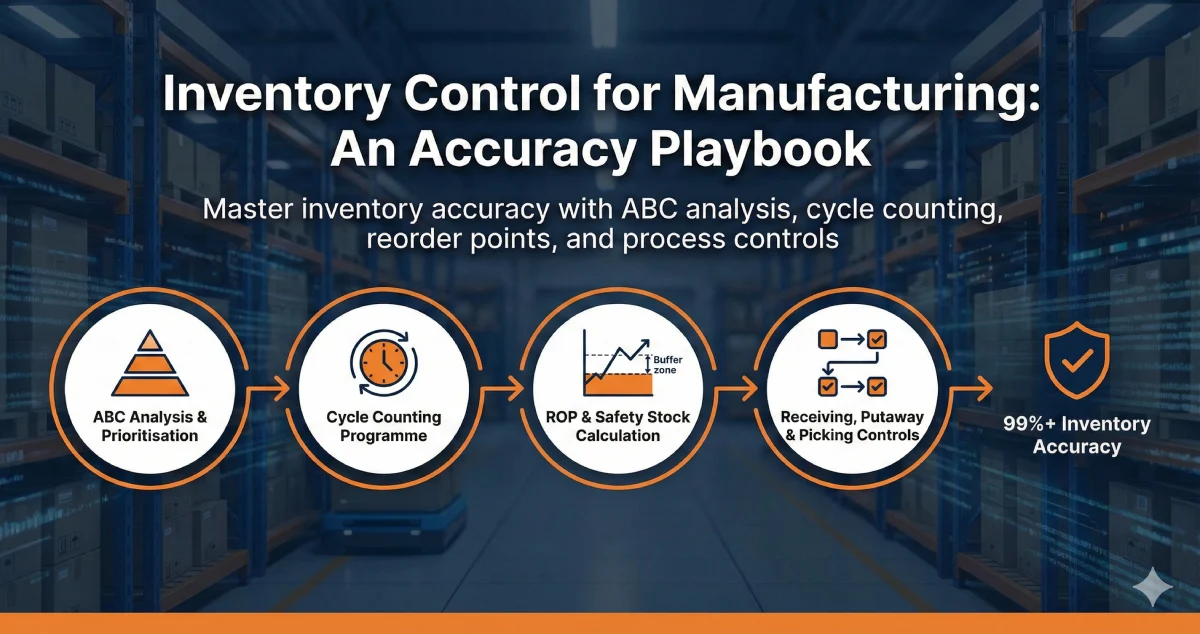
Inventory Control for Manufacturing: An Accuracy Playbook
Improve inventory accuracy with practical ABC analysis, cycle counting, reorder points, and standard receiving/picking controls—built for manufacturing and wholesale teams.
Operations Playbook • Manufacturing & Wholesale
Inventory Control for Manufacturing: An Accuracy Playbook Your Team Can Actually Run
If inventory accuracy is drifting, the symptom is usually visible (stockouts, expediting, “missing” items),
but the root cause is operational: weak item master governance, inconsistent receiving/putaway,
uncontrolled adjustments, and a cycle counting programme that’s not engineered for reality.
This playbook shows a practical path to measurable improvement using
ABC analysis,
cycle counting,
and reorder points—without turning your operation into a paperwork factory.
In manufacturing and wholesale, poor inventory accuracy isn’t just a warehouse problem—it becomes a commercial problem.
Sales promises dates that operations can’t meet. Purchasing overbuys “just in case.” Production schedules get rebuilt daily.
And finance loses confidence in stock valuation.
Operational friction
Expediting, rework, manual searching, and time lost to “inventory detective work”.
Customer impact
Missed ship dates, partial deliveries, and avoidable backorders damage trust.
Financial distortion
Adjustments without governance erode margin visibility and audit confidence.
The fix is rarely “count everything more often.” The fix is a controlled operating model:
clean data,
consistent transactions,
and a cycle counting programme designed around risk.
Step 1 — Define Inventory Accuracy Properly (Not Just “Count vs System”)
If you only measure “quantity accuracy,” you will miss the real drivers. Strong inventory control for manufacturing
tracks four accuracy types:
Quantity accuracy: system quantity vs physical quantity.
Location accuracy: is the item in the expected bin/location?
Transaction accuracy: receipts, issues, transfers posted correctly and on time.
Master data accuracy: UoM, pack sizes, lead time, lot/serial rules, min/max.
Baseline assessment (fast and honest)
Start with a limited, high-signal audit: pick 30–50 SKUs across A/B/C and check quantity, location, and transaction history.
The objective isn’t to “pass”—it’s to isolate the dominant failure mode.
Do discrepancies cluster by supplier, shift, zone, or item family?
Are issues driven by receiving, picking, production consumption, or adjustments?
Do errors correlate with poor bin discipline or uncontrolled transfers?
Step 2 — Build the Data Foundation (So Counts Don’t Lie)
Cycle counting cannot outperform bad data. Before you scale counting, stabilise the basics:
item master standards, location structure, and transaction rules.
Item master essentials
One primary UoM + controlled alternates (no “informal” units)
Pack size, MOQ, supplier lead time, and ordering multiples
Lot/serial rules where traceability is required
ABC class, storage type, and handling constraints
Location and bin discipline
Consistent location naming (site → zone → aisle → bay → level → bin)
Quarantine / QC hold locations to prevent “ghost stock”
Transfer rules: every move is a transaction, not a habit
Cycle counts validate location accuracy, not only quantity
Step 3 — ABC Analysis That Actually Works (Value + Volatility)
Basic ABC analysis ranks items by annual usage value (demand × cost). That’s a good start—but manufacturing and wholesale
operations also need to account for volatility and service risk.
A practical ABC model
Use two lenses:
Value (annual usage value) and
Volatility (demand variability, supplier variability, or criticality to production).
A items
High value or high risk. Tight controls. Highest count frequency.
B items
Moderate value/risk. Standard controls. Routine cadence.
This approach prevents a common failure: obsessing over low-value items while high-impact SKUs drift quietly.
Step 4 — Build a Cycle Counting Programme (30/60/90-Day Progress)
A cycle counting programme is not “count whenever we have time.” It’s a controlled operational routine with clear rules:
who counts, how counts are executed, how discrepancies are investigated, and what corrective actions are enforced.
Step 5 — Reorder Points and Safety Stock (So You Stop “Buying by Panic”)
Reorder points fail when lead times are guessed, demand variability is ignored, and pack sizes/MOQs are not respected.
A workable approach doesn’t need perfect statistics—just consistent logic and disciplined updates.
A practical formula (operational version)
Reorder Point (ROP) =
(Average demand during lead time) +
(Safety stock)
Where safety stock comes from (without over-complication)
Supplier variability: if lead time slips, protect A items first.
Demand variability: if orders spike, protect items with high volatility.
Service target: decide what “good” looks like (e.g., no stockouts for top customers).
The objective is not theoretical perfection—it’s reducing stockouts and expediting while keeping inventory rational.
Step 6 — Receiving, Putaway, Picking: Standard Work That Protects Accuracy
Most accuracy loss happens through “normal work.” Tighten three areas: receiving, internal transfers, and picking.
You don’t need bureaucracy—you need clear checkpoints.
Receiving
GRN posted same day (no “later” backlogs)
QC hold locations prevent premature availability
UoM and pack verification at the dock
Putaway & transfers
Bin confirmation is mandatory
Every movement is a logged transaction
Quarantine rules for exceptions
Picking
Pick lists enforce location discipline
Short-picks trigger investigation, not workarounds
Serial/lot capture where required
Step 7 — Governance: Adjustments, Approvals, and Audit Trail
Inventory adjustments are sometimes necessary—but they must be governed. Otherwise, your system becomes a diary of excuses.
Strong inventory control for manufacturing uses approvals and reason codes to keep the truth intact.
Adjustment controls (minimum viable governance)
Role-based access: only authorised roles can adjust stock.
Two-step approval: threshold-based (e.g., value or quantity variance).
Audit trail: who changed what, when, and reference document(s).
Step 8 — Dashboards: What to Review Weekly (So It Stays Fixed)
Inventory accuracy is not a one-time project. It’s an operating rhythm. The best teams review a small set of indicators weekly
and enforce corrective action consistently.
Weekly scorecard (high-signal metrics)
Count accuracy trend by A/B/C
Top variance SKUs and top variance locations
Open receipts / delayed postings
Negative stock / backdated adjustments
Root-cause distribution (what’s actually causing drift)
System vs Spreadsheet: When You Need a Proper Inventory Control Layer
Spreadsheets can help you diagnose issues, but they struggle to enforce rules at the moment work happens:
receiving, transfers, picking, and approvals. If accuracy depends on “remembering” steps, it will regress.
Spreadsheets can work when
SKU count is low and locations are simple
Adjustments are rare and controlled
Receiving/picking is stable and disciplined
You need a system layer when
Multiple sites, bins, shifts, or teams touch stock
Traceability (lot/serial) is required
Approvals and audit trail are non-negotiable
Lead times and reorder logic need governance
Next step (if you want this implemented)
If you're building out inventory controls in an ERP or a custom operational stack, start with a clean workflow design:
data standards, transaction rules, approvals, and reporting. That is how accuracy becomes sustainable.
What is a “good” inventory accuracy target for manufacturing?
Focus on improving accuracy where it matters: high-impact items (A class) and critical locations.
Targets depend on complexity, but the practical goal is consistent improvement supported by root-cause reduction,
not a one-off “perfect count”.
How do we choose cycle count frequency?
Use ABC class plus volatility/criticality. A items should be counted weekly or bi-weekly, B monthly,
C quarterly. Then adjust based on where variance repeats.
Why do reorder points fail even when we calculate them?
Because lead times drift, demand changes, and pack constraints are ignored. ROP must be governed:
updated regularly, tied to supplier performance, and aligned with MOQ/pack sizes.
What is the fastest way to stabilise inventory control?
Stabilise receiving and transfers first (post transactions same day, enforce bin discipline),
then implement a cycle counting programme with blind counts and variance governance.
How does this connect to manufacturing and wholesale operations?
In manufacturing, accuracy protects production scheduling and material availability.
In wholesale, it protects fulfilment reliability and customer promise dates.
Both require audit-ready controls and consistent transaction discipline.
A final note for manufacturing & wholesale teams
If your organisation is scaling, the question isn’t whether you should improve inventory accuracy—the question is
whether you want it to be a recurring fire drill or a controlled operating model. The difference is governance,
transaction discipline, and a cycle counting programme designed for the reality of your operation.