If you would like to receive a quote for your project or discuss long-term or short-term business opportunities with me, Schedule an Appointment now.

On-time
Tech
Support
By Tuğrul Yıldırım

Quote-to-Cash CRM Blueprint for Manufacturing & Wholesale

Quote-to-Cash for Manufacturing & Wholesale: A Practical CRM Blueprint (Data, Workflows, Integrations)

Build a manufacturing & wholesale CRM that speeds up quoting, approvals, and order handoffs. Learn the data model, workflow automation, and CRM–ERP integration blueprint.
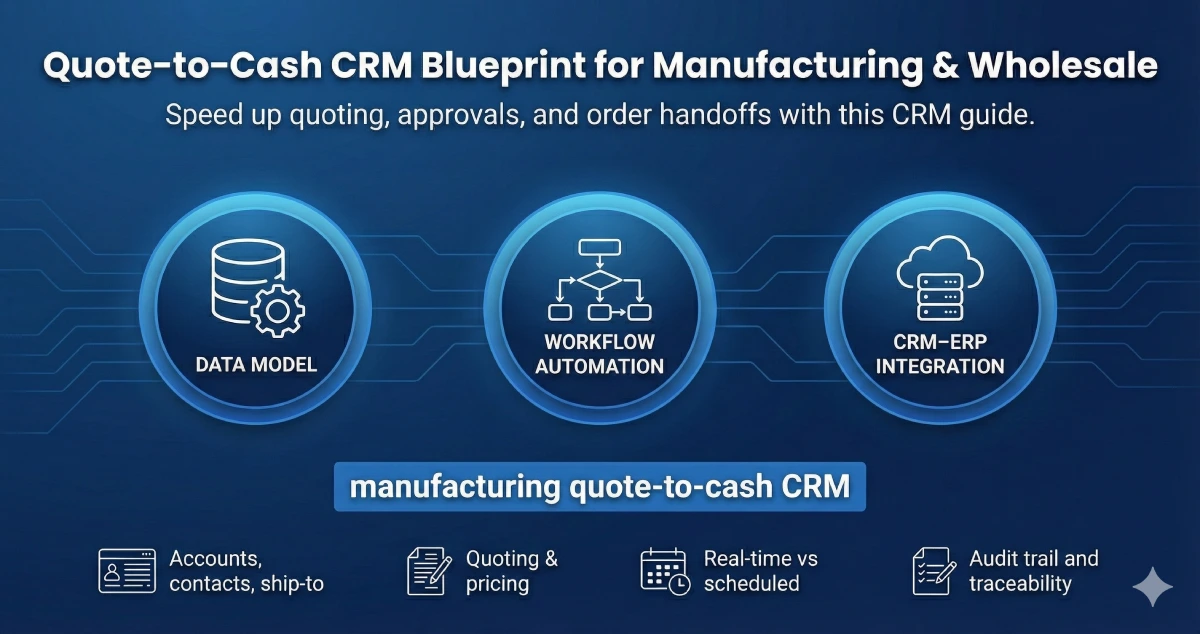
Quote-to-Cash CRM Blueprint for Manufacturing & Wholesale
Manufacturing & Wholesale CRM Quote-to-Cash Playbook Practical • Implementation-focused • API-ready

Quote-to-Cash for Manufacturing & Wholesale: A Practical CRM Blueprint

This guide is designed for teams who want predictable sales execution without spreadsheet chaos. You’ll get a clear workflow map, a clean data model, and a pragmatic integration approach that connects front-office CRM with back-office operations.

Response within 24 hours Clear scope & timeline Documentation included

Executive summary

A manufacturing quote-to-cash CRM should do one job exceptionally well: move deals from quoting to cash with control—pricing discipline, approvals, handoffs, and traceability. If your team relies on spreadsheets, inbox approvals, and “tribal knowledge,” you don’t have a system. You have risk.

This blueprint focuses on the three levers that consistently create operational clarity: (1) workflow, (2) data model, and (3) integrations.

Why manufacturing & wholesale CRM is different

In manufacturing & wholesale CRM, the “sale” is rarely a single-click purchase. It typically includes quoting complexity, negotiated terms, multi-step approvals, partial fulfilment, and back-office constraints (stock, production capacity, procurement, credit limits).

The hidden cost of spreadsheets

  • Pricing decisions are inconsistent (and impossible to audit).
  • Approvals live in chat/email, not in a controlled workflow.
  • Handoffs fail: sales promises don’t match operations reality.
  • No single source of truth: customer history is fragmented.

Where generic CRMs break

Generic CRMs handle contacts and pipelines. They often fail at quoting governance, margin guardrails, approval chains, and operational handoffs. The result: teams “work around” the CRM—then management loses visibility and trust in reporting.

Positioning note

If you want a CRM that your team actually uses, don’t start with “features.” Start with repeatable workflows and clear ownership.

The quote-to-cash workflow (lead → invoice)

Quote-to-cash is the operational spine of B2B sales. Done properly, it reduces friction for both your team and your customers. Here is the workflow you want your CRM to enforce—not merely “track.”

1) Quoting & pricing

  • Controlled price lists and customer-specific terms
  • Margin guardrails and discount thresholds
  • Versioning for quote revisions

2) Approvals & traceability

  • Approval chains by value, margin, or customer risk
  • Who approved what, when, and why (audit trail)
  • Clear SLA ownership to prevent stalled deals

3) Order handoff & fulfilment signals

  • Convert approved quotes into orders reliably
  • Stock/production constraints visible to sales
  • Status updates flow back to the customer context

4) Invoicing & collections alignment

  • Terms and billing data validated upfront
  • Fewer disputes due to clean order history
  • Faster cash because handoffs are structured

A data model that prevents chaos

Most CRM projects fail quietly because of inconsistent master data. If you want reliable reporting and reliable integrations, your data model must be deliberate.

Core entities you need (minimum viable structure)

Commercial structure

  • Account (company) + Contact(s)
  • Ship-to / Bill-to addresses
  • Payment terms, credit notes, tax rules
  • Opportunity / Deal + stages

Product & pricing structure

  • Items / SKUs + units
  • Price lists (global + customer-specific)
  • Quote + quote lines
  • Discount rules + approval thresholds

Data governance basics (don’t skip)

  • Ownership: who can create/edit customers, pricing, terms
  • Identifiers: stable IDs across systems (avoid “name-based matching”)
  • Audit fields: created_by, approved_by, approved_at, change reasons

CRM–ERP integration blueprint (API-first, controlled, observable)

A strong integration is not “a connection.” It is a controlled data contract with monitoring, retries, and predictable behaviour. For manufacturing and wholesale, integrations must protect operations from sales noise—and protect sales from operational blind spots.

What should be real-time vs scheduled?

  • Real-time: order status, stock signals, approval outcomes
  • Scheduled: price list syncs, large catalog updates, finance batches

API contracts that prevent surprises

  • Versioned endpoints and payloads
  • Idempotency for safe retries
  • Structured logs + correlation IDs

Error handling playbook (non-negotiable)

Integrations fail. Mature systems fail gracefully. Your baseline should include: automatic retries with backoff, dead-letter logging, a visible queue dashboard, and clear ownership for “fix and replay.”

If your CRM and ERP don’t agree, your team will stop trusting both.

If you want a practical integration plan for your manufacturing or wholesale stack, request a roadmap that prioritises outcomes over complexity.

30–90 day implementation roadmap

The fastest way to reduce risk is phased delivery. You don’t need everything at once—you need the right foundations, then automation, then governance.

Phase 1 (0–30 days)

  • Define the quote-to-cash stages and ownership
  • Build the core entities (accounts, items, quotes)
  • Set pricing guardrails and approval rules
  • Establish audit trail foundations

Phase 2 (31–60 days)

  • Automate tasks, SLAs, and follow-ups
  • Implement approval workflows + quote versioning
  • Introduce integration contracts (API-first)
  • Start operational dashboards people trust

Phase 3 (61–90 days)

  • Expand integrations (orders, stock signals, invoicing)
  • Add governance: roles, permissions, change reasons
  • Harden observability: queues, retries, alerts
  • Optimise performance on critical screens

Common pitfalls (and how to avoid them)

  • Building features before workflow: start with the quote-to-cash stages, not UI.
  • No pricing governance: if discounts aren’t controlled, margins will leak.
  • Point-to-point integration chaos: define contracts, versioning, and monitoring early.
Avoid “over-customisation” without governance

Custom is powerful when it’s managed. Without role design, approvals, and auditability, custom becomes brittle and expensive. Build flexibility with guardrails.

FAQ

Ready to turn quote-to-cash into a predictable system?

If you want a manufacturing & wholesale CRM that your team trusts—and integrations that don’t create chaos—start with a practical roadmap.

Share this article

Related Articles

Continue reading with these related articles on CRM, ERP, and API integrations.

Need help implementing these insights?

Get a practical scope direction and integration roadmap for your CRM, ERP, or API project.

Typical response within 24 hours · Clear scope & timeline · Documentation included