Laravel
React
WebSocket
REST API
Risk Automation
MCP / AI Context
Event-Driven Cryptocurrency Analysis and Risk Automation Platform
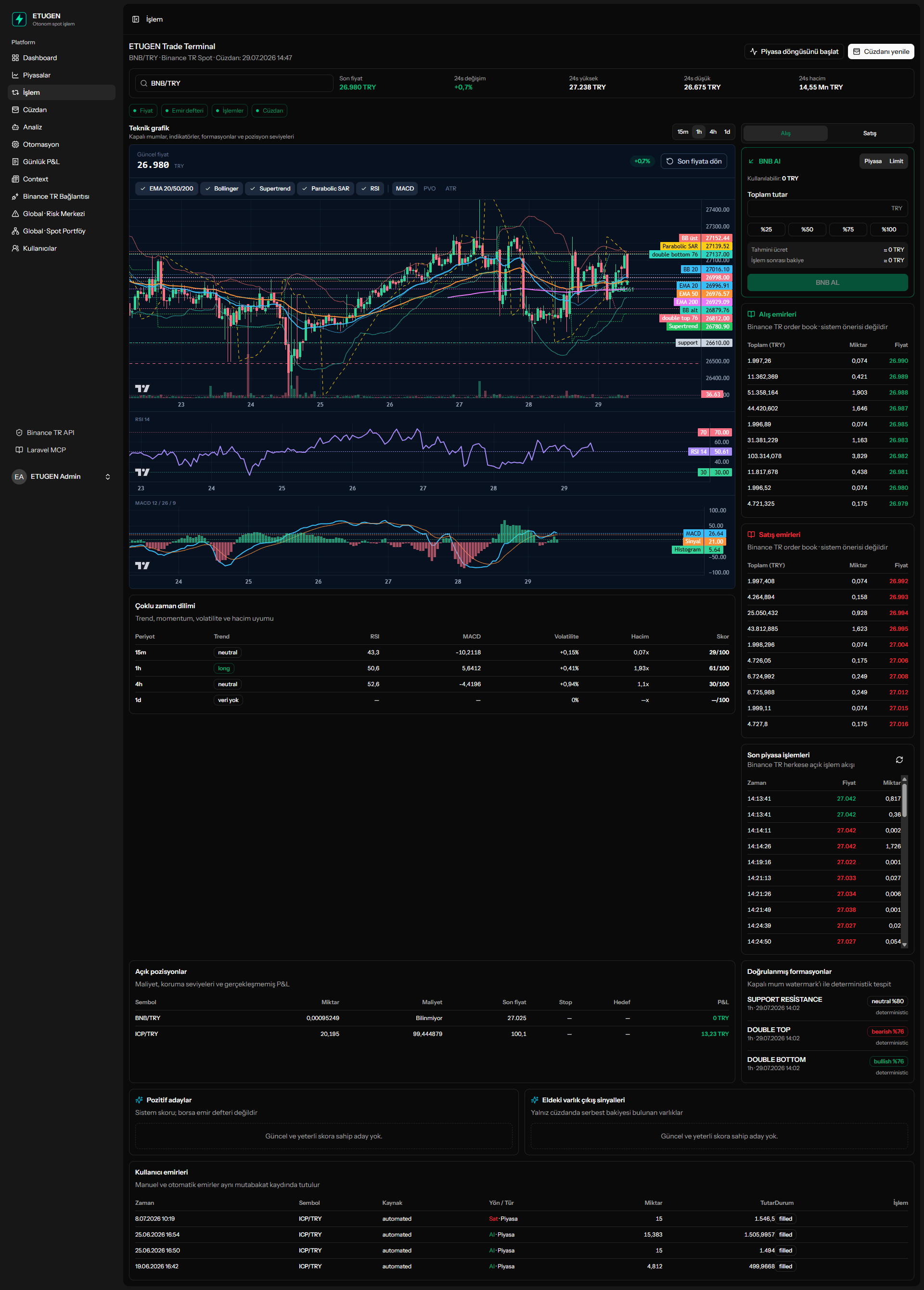
ERİDU is a software engineering project built around a fundamental question:
how can fast-moving market data, technical events, external context and strict risk limits
be processed through a traceable and deterministic automation pipeline
instead of relying on opaque decisions?
I designed the platform as a combination of market-data processing, technical event detection,
risk controls, API integrations and real-time application infrastructure.
Signals are treated as structured software events rather than predictions:
each stage produces evidence that can be inspected, logged and evaluated before the workflow progresses.
The project also explores the controlled use of AI and
Model Context Protocol (MCP) within an automation system.
AI can enrich market context and summarize external information, while deterministic rules,
risk limits and system state remain the final authority.
The Engineering Challenge
Market automation systems operate in an environment where data can become stale,
events can arrive out of sequence, API calls can fail and a technically valid signal
can still be unacceptable from a risk perspective.
Building a reliable system therefore requires much more than calculating indicators.
The application must know when the data was produced, which closed candle generated an event,
what market context was available, which risk rules were applied and whether every downstream action
was actually confirmed.
Data Reliability
Decisions must use known market snapshots and closed-candle data rather than silently mixing
incomplete or temporally inconsistent inputs.
Risk Before Execution
A technical event is only one input. Exposure, loss limits, system health
and configured risk restrictions must be evaluated separately.
API Failure Handling
Network timeouts and ambiguous exchange responses cannot be treated as confirmed outcomes.
Every critical state transition needs explicit verification.
Explainable Decisions
Events, context, risk gates and system responses should remain traceable
so an operator can reconstruct why the workflow advanced or stopped.
Event-Driven Analysis Architecture
ERİDU separates signal detection from risk evaluation and execution-related state management.
This prevents one indicator or one AI-generated interpretation from becoming an uncontrolled system decision.
-
1
Market Data
Price, volume and closed-candle market information enters the analytical pipeline.
The data timestamp and source become part of the event context.
-
2
Technical Event Detection
Indicator combinations and strategy rules produce immutable technical events
instead of directly triggering an opaque action.
-
3
Context Enrichment
Market regime, external events, news context and other supporting signals
can enrich the technical event without replacing deterministic decision logic.
-
4
Risk Engine
Configured exposure, loss, position-sizing and system-health rules determine
whether an event is allowed to progress.
-
5
State Reconciliation
Downstream operations are reconciled against the external system before the automation
accepts them as completed state transitions.
Risk Controls as a First-Class Software Layer
ERİDU was designed with risk management separated from technical signal generation.
A strong market signal does not bypass account-level or system-level restrictions.
Risk controls are evaluated as independent gates.
Daily Loss Protection
New activity can be suspended when configured loss limits are reached,
preventing a strategy from continuing unrestricted during abnormal conditions.
Position Sizing Controls
Exposure can be constrained relative to account state and configured risk parameters
rather than using uncontrolled fixed quantities.
Kill Switch
System-wide protection can halt new activity when health checks,
unusual market conditions or other safety rules indicate unacceptable operational risk.
Order Reconciliation
Requested and actual external-system state are compared so a timeout,
partial response or failed cancellation cannot silently become internal truth.
AI Enriches Context — It Does Not Own the Decision
ERİDU uses AI-oriented components differently from systems that delegate the final decision
to a language model. LLM and MCP integrations can analyze supporting context such as news,
market conditions or structured external signals, but they do not replace the deterministic
technical and risk engine.
This architecture allows AI output to remain an advisory context layer.
The automation can challenge, reduce or reject risk while keeping hard limits and system state
outside probabilistic model control.
External Context
Market events, news and contextual signals.
MCP / AI Layer
Structured contextual analysis and independent risk challenge.
Deterministic Engine
Hard risk gates, system rules and final state validation.
API and Real-Time Integration Architecture
ERİDU combines synchronous APIs, real-time data streams and internal event processing.
REST APIs provide controlled access to application services while WebSocket-driven components
support continuously changing data and operational state.
| Architecture Area |
Responsibility |
Engineering Goal |
|
Market data
|
Price, candle, volume and market-state ingestion
|
Timestamped and traceable analysis inputs
|
|
WebSocket layer
|
Real-time data and state updates
|
Reduce polling and improve state freshness
|
|
REST API
|
Application services and controlled integrations
|
Clear contracts between system components
|
|
Event engine
|
Technical event creation and workflow transitions
|
Reproducible and inspectable decision history
|
|
Risk engine
|
Position, exposure and protection rules
|
Prevent technical events from bypassing hard limits
|
|
Reconciliation
|
Compare requested actions with external state
|
Detect ambiguous, incomplete or inconsistent outcomes
|
The same reliability principles apply to enterprise integration work:
versioned contracts, idempotency, observability and reconciliation.
See
API Integration Services
for the broader architecture approach.
Traceability Instead of Black-Box Automation
One of the primary engineering goals of ERİDU is reconstructability.
A later investigation should be able to determine which market event existed,
what supporting context was available, what risk rules were active and which state transitions occurred.
Immutable Technical Events
Preserve the analytical event that triggered evaluation.
Timestamped Context
Keep supporting information tied to the correct market moment.
Risk Decision History
Record which rules reduced, blocked or permitted workflow progression.
External State Reconciliation
Verify that internal assumptions match the actual external-system state.
Technical Scope
Laravel Backend
Domain logic, API services, event processing, persistence and automation orchestration.
React Interface
Interactive dashboards and real-time operational interfaces.
WebSocket Data Flow
Real-time market and operational state propagation.
REST API Integration
Structured communication between application services and external systems.
Deterministic Risk Engine
Hard risk gates separated from market-signal generation.
MCP & AI Integration
Controlled contextual analysis without delegating final system authority to probabilistic models.
Reconciliation Layer
Verification of requested operations against actual external-system state.
Observability & Auditability
Traceable events, system decisions and risk-state history for operational analysis.
A Real-Time Automation Project Beyond Conventional CRUD Applications
ERİDU demonstrates an architecture built around continuously changing external data,
asynchronous events, real-time interfaces, deterministic business rules, AI-assisted context,
operational safeguards and external-system reconciliation.
Although the domain is cryptocurrency market automation, the engineering principles are directly applicable
to enterprise systems: event-driven workflows, state machines, API resilience, idempotency,
audit trails, observability, rule engines and safety-first automation.
These same architectural patterns can be applied to CRM/ERP integrations, industrial automation,
financial workflows, order-processing platforms and other systems where an incorrect state transition
has real operational consequences.
Project scope:
ERİDU is presented as a software engineering and technical automation project.
It does not provide investment advice, guarantee returns or replace the user's own risk assessment.