Laravel 12
Livewire 4
Manufacturing ERP
Production Planning
Inventory & Procurement
Quality Control
Finance & Payroll
API / MCP / AI
A Private Manufacturing ERP Built Around Real Factory Operations
This project is a large-scale, purpose-built ERP application developed for the internal operations
of a manufacturing business. It is not a generic SaaS product and was not designed
around a pre-packaged ERP template. The system has evolved directly around real production,
sales, inventory, procurement, logistics, quality, finance and workforce processes.
What initially began as an operational foundation grew into an interconnected manufacturing platform
where a customer order can be followed through product configuration, material requirements,
customer-reserved stock, production planning, work orders, procurement, warehouse operations,
shipment, delivery, financial exposure and reporting.
The architectural objective is not simply to store records. The ERP acts as an
operational source of truth, connecting decisions made by sales,
production, purchasing, warehouse, logistics, quality, finance and HR teams while
preserving permissions, transaction integrity and traceability across those workflows.
ERP Scope: From Customer Demand to Factory Execution
Manufacturing operations cannot be represented accurately by isolated CRM, inventory or production screens.
A customer order affects material demand; material demand affects procurement and production;
production affects customer-reserved stock; available stock affects shipment planning;
and shipment events affect both financial exposure and customer order completion.
The application therefore uses connected domain workflows rather than treating each department
as an independent software module.
Commercial
Customer & Orders
Customer records, account ownership, addresses, contacts, customer-specific product codes,
price lists, order lines, discounts, currencies and commercial documents.
Planning
Production
Production plans, work orders, recipes, production lines, machines,
molds, operator reporting, approvals, waste and production progress.
Supply
Stock & Procurement
Inventory buckets, customer stock reservations, material requirements,
purchase requests, supplier options, arrivals, returns and physical stock tracking.
Fulfilment
Shipment & Finance
Shipment planning, warehouse confirmation, logistics costs, export documents,
currency exposure, collections, margins and operational reporting.
Customer, CRM and Order Management
Customer management extends beyond a conventional contact database.
Customer records are connected directly to orders, representatives, addresses,
authorized contacts, product codes, reserved stocks, financial information,
purchasing requirements and operational history.
Customer Master Data
- Customer profiles and account ownership
- Billing and delivery addresses
- Authorized contacts and communication addresses
- Industry and customer-region assignments
- Assigned sales representatives
- Role-aware customer visibility
- Customer wallets and payment history
- Customer-specific intelligence and notes
Customer-Specific Product Context
- Internal and customer-specific product codes
- Customer-specific default recipes
- Product labels and barcode-related requirements
- Customer-reserved finished goods stock
- Standard and special-order stock reservations
- Order-specific product and recipe snapshots
- Customer-linked procurement requirements
- Historical order and fulfilment context
Order Management Is the Operational Backbone
Orders are modeled as operational objects rather than simple sales records.
A single order may carry customer-specific pricing, currency snapshots,
packaging rules, quantities expressed as units or cases, technical recipes,
customer product codes, shipment status and production requirements.
Price & Currency Control
Price lists, historical currency snapshots, tax, primary and secondary discounts,
and customer-specific commercial terms.
Unit & Packaging Logic
Separate box, case and pieces-per-case rules prevent ambiguous quantity calculations
between sales, production, shipment and reporting.
Order-Level Recipes
Recipes can be copied from customer or product defaults and then frozen or adjusted
specifically for the individual order.
Controlled Lifecycle
Order state, production, procurement, shipment, delivery and financial context remain linked
throughout the order lifecycle.
Product Master Data, Recipes and Manufacturing Structure
Product data is used by nearly every other ERP domain.
Products can participate in customer orders, recipes, procurement,
stock movements, production plans, quality rules and shipping calculations.
The application supports the distinction between finished goods,
semi-finished products, raw materials, packaging components and other
production-relevant item types instead of reducing everything to a generic SKU.
Product Recipes / BOM
Finished products can consume raw materials, semi-finished products,
packaging materials or other manufactured components through recipe relationships.
Nested Requirements
Material requirement calculations can recursively expand semi-finished products,
making downstream manufacturing requirements visible before production begins.
Sets & Assemblies
Set products and their underlying manufactured components are handled as connected
production structures rather than flat order lines.
Packaging Dimensions
Product and delivery packaging data feeds weight, volume, packing list
and shipment calculations.
Stock Tracking Modes
Different products can use standard quantity tracking or more detailed physical-unit
models such as individually tracked raw-material rolls.
Quality Relationships
Product-specific quality rules can be associated with production processes
and evaluated as part of manufacturing control.
Inventory, Reserved Stock and Material Availability
Inventory is not represented by one stock number.
Different quantities have different operational meanings:
usable stock, semi-finished stock, customer-reserved stock,
standard sales allocations and special-order allocations must remain distinguishable.
This becomes particularly important when production and procurement are calculated
against actual customer demand. A product may physically exist in the warehouse
while already being reserved for another customer or production requirement.
| Inventory Concern |
ERP Capability |
Operational Purpose |
|
General stock
|
Product-level inventory buckets
|
Understand physically and operationally available quantities
|
|
Customer reservations
|
Customer-specific stock allocations
|
Prevent one customer's reserved production from appearing freely available
|
|
Critical stock
|
Minimum usable-stock thresholds
|
Identify materials requiring attention before production is blocked
|
|
Recipe demand
|
Material requirement and stock-gap calculations
|
Convert production demand into material requirements
|
|
Physical material units
|
Individually tracked rolls and movement history
|
Preserve physical traceability for weight-based raw materials
|
|
Auditability
|
Stock movement records and reconciliation
|
Explain why inventory changed rather than showing only the latest balance
|
Physical Roll Tracking for Weight-Based Raw Materials
Some manufacturing materials cannot be managed accurately with only a generic kilogram balance.
Individual material rolls can have their own identity, remaining weight,
supplier lot, dimensions, warehouse location and movement history.
For applicable raw and semi-finished materials, the ERP supports individually identified rolls.
A roll number can be reserved during procurement, activated when the physical material arrives,
consumed during production and adjusted through controlled usage, waste and reversal movements.
Unique Material Identity
Physical rolls can retain unique codes independent of aggregate product stock.
Actual Weight Tracking
Planned procurement weight and actual received or remaining weight remain distinguishable.
Production Consumption
Operators can associate physical material consumption and waste with production records.
Reversible Audit Trail
Corrections use controlled reversal movements instead of deleting historical stock evidence.
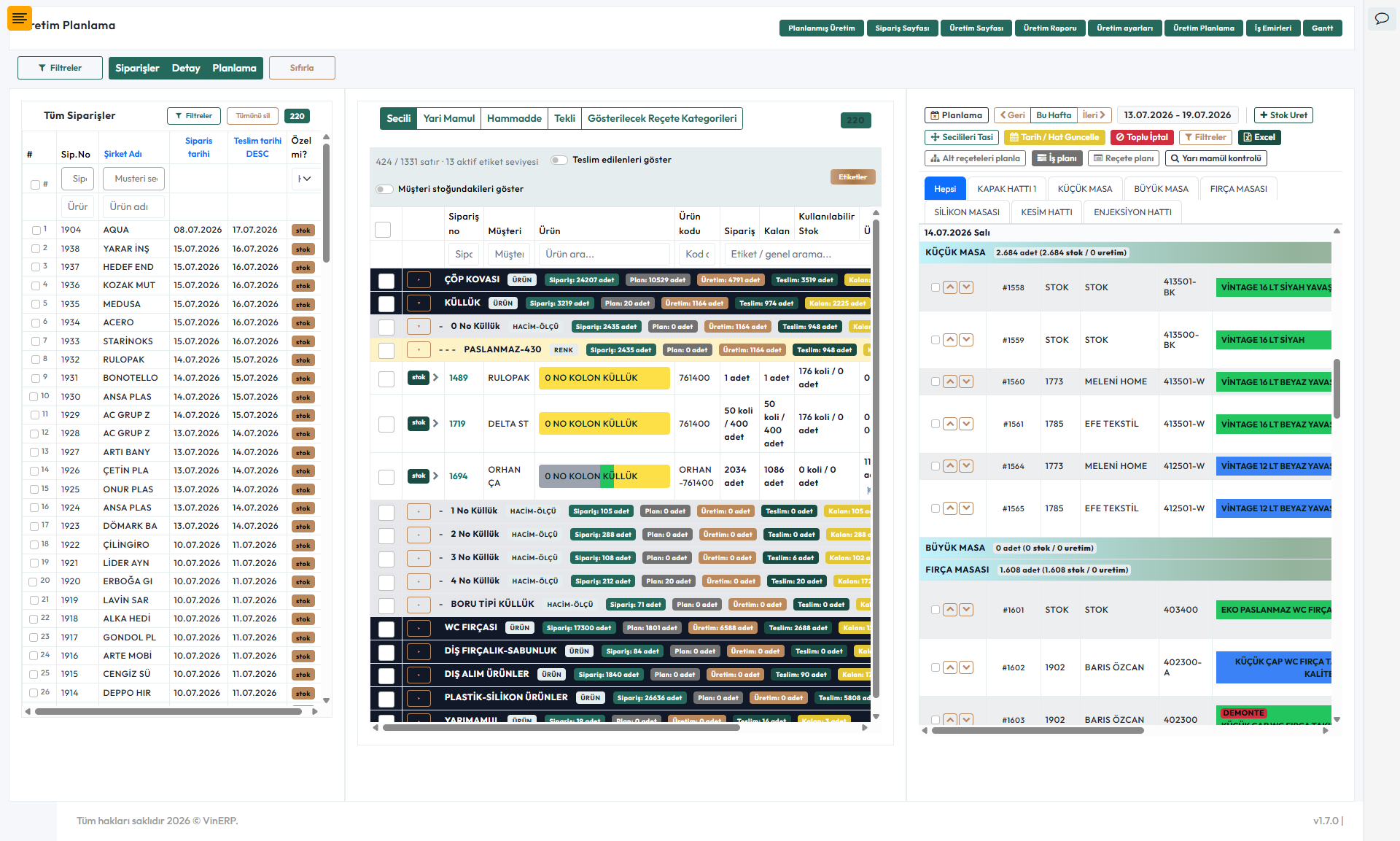
Production Planning and Shop-Floor Execution
Production is modeled from planning through execution rather than as a final quantity entry.
Plans can be linked directly to customer orders or opened for general stock production.
The planning model understands production lines, manufacturing departments,
machines, molds, nested production requirements and the relationship between
finished goods and the semi-finished components required to manufacture them.
Production Lines
Hierarchical production lines and manufacturing departments model
the actual structure of the factory floor.
Machines & Molds
Production can be associated with specific machines and molds,
allowing planning to reflect physical manufacturing constraints.
Daily Planning
Daily production records retain planned quantities, completed quantities,
transfers, progress, dates and operational status.
Work Orders
Workshop-style work orders provide an additional planning layer for operations
that require capacity-oriented scheduling rather than only daily quantity planning.
Gantt Planning
Production workloads can be represented through timeline-oriented planning views
for more complex workshop and machine schedules.
Production Transfers
Incomplete work can be transferred to future production plans without
falsifying the quantity actually completed on the original day.
Operator Reporting, Production Time and Approval Workflow
Shop-floor production is not immediately treated as official inventory.
Operators can report production activity, while completed quantities pass through
a separate approval process before becoming authoritative production state.
Start
Record when production activity actually begins.
Stop
Capture interruptions, downtime reasons and operator notes.
Resume / Finish
Build a usable production-time history instead of relying only on plan dates.
Approval
Separate operator-reported output from officially approved production and stock movement.
Example Order-to-Production Flow
Every stage can retain its own operational state while remaining connected to the original
customer order. This allows teams to investigate the cause of a delay instead of seeing only
a generic “order pending” status.
Procurement and Supplier Operations
Procurement is demand-aware. Purchase requests can originate from general operational needs
or be tied directly to a customer order and its individual order line.
This preserves the relationship between the commercial commitment and the material being purchased.
Purchase Request Management
- Product and requested quantity
- Requesting employee
- Optional preferred supplier
- Customer and order relationship
- Open and purchased quantities
- Return quantities
- Request grouping through procurement carts
Supplier & Purchase Decisions
- Supplier-specific price options
- One-time negotiated purchase prices
- Tax and discount calculations
- Supplier payment terms
- Minimum order considerations
- Historical purchase context
- Supplier performance and quality context
Partial Purchasing and Partial Arrivals
A purchase request does not need to be fulfilled by one supplier or one delivery.
The same requirement can be purchased in parts, and each purchase can itself arrive
through multiple delivery records.
Requested
Material requirement
Purchased
One or more supplier orders
Received
One or more warehouse arrivals
Quality Control and Non-Conformance Management
Quality control is modeled as an operational gate rather than a note field added after production.
Quality rules can be assigned to products or production records and evaluated during manufacturing.
Quality Rules
- Reusable quality rules
- Product-level rule assignments
- Production-specific quality requirements
- Production quality checks
- Quality-gate completion status
Non-Conformance
- Non-conformance reports
- Corrective or related actions
- Production-linked quality evidence
- Structured exception history
- Traceability between production and quality outcomes
Shipment Planning, Warehouse Handoff and Logistics
Shipment planning is connected to actual customer-order lines.
A shipment may contain lines from one or multiple orders and preserves quantities,
package quantities, weight, volume, customer, product and fulfilment state.
Planning and warehouse execution are deliberately separated.
The quantity planned for shipment is not automatically considered shipped;
warehouse-reported and approved quantities determine the authoritative delivery state.
Multi-Order Shipments
One logistics plan can combine appropriate lines from multiple customer orders.
Warehouse Confirmation
Actual warehouse quantities remain separate from the quantities originally planned.
Weight & Volume
Packaging dimensions, quantities, net weight and gross weight support logistics calculations.
Loading Records
Loading and operational shipment-time information can be retained for logistics analysis.
Returns
Return shipments remain distinguishable and feed net shipment and reporting calculations.
Logistics Costs
Freight, driver, customs and other shipment costs can be tracked independently and reflected in reports.
Commercial, Warehouse and Export Document Generation
ERP data is also used to generate operational and customer-facing documents.
Document rendering shares the same order and shipment calculation rules instead of
independently reimplementing totals in each PDF template.
Heavy document generation can be queued instead of blocking the user's page request,
while generated documents retain order and user context.
Finance, Currency Exposure and Margin Visibility
The financial reporting layer connects commercial value with operational events.
It does not look only at the price written on the order: purchase costs,
shipment costs, payments, currency movements and delivery dates can all affect
the economic interpretation of an order.
Currency & Exposure
- Order-time currency snapshots
- Current and historical exchange-rate comparison
- Delivery-date exchange-rate context
- Currency-difference reporting
- Revaluation runs
- Inflation-aware operational analysis
Margin & Collection Context
- Order revenue
- Order-linked purchasing cost
- Shipment additional costs
- Estimated operational margin
- Remaining receivables
- Payment allocations
This allows management reporting to answer more useful questions than
“what was the sales price?”—for example, what was purchased for the order,
what logistics costs were incurred, how currency moved and what margin remains after those effects.
HR, Attendance, Shifts and Payroll
Workforce management is integrated as another operational domain.
Employee profiles, shifts, attendance, overtime, field-work attendance,
payroll calculations and payroll-accounting export records can be managed within the ERP.
Attendance
Attendance events can arrive from devices, integrations,
imported files or controlled mobile workflows.
Shift Planning
Shift templates, employee assignments, weekly calendars,
tolerances and manual overrides support factory scheduling.
Overtime Approval
Calculated overtime can remain operationally visible while only approved overtime
is included in payroll calculations.
Mobile Field Attendance
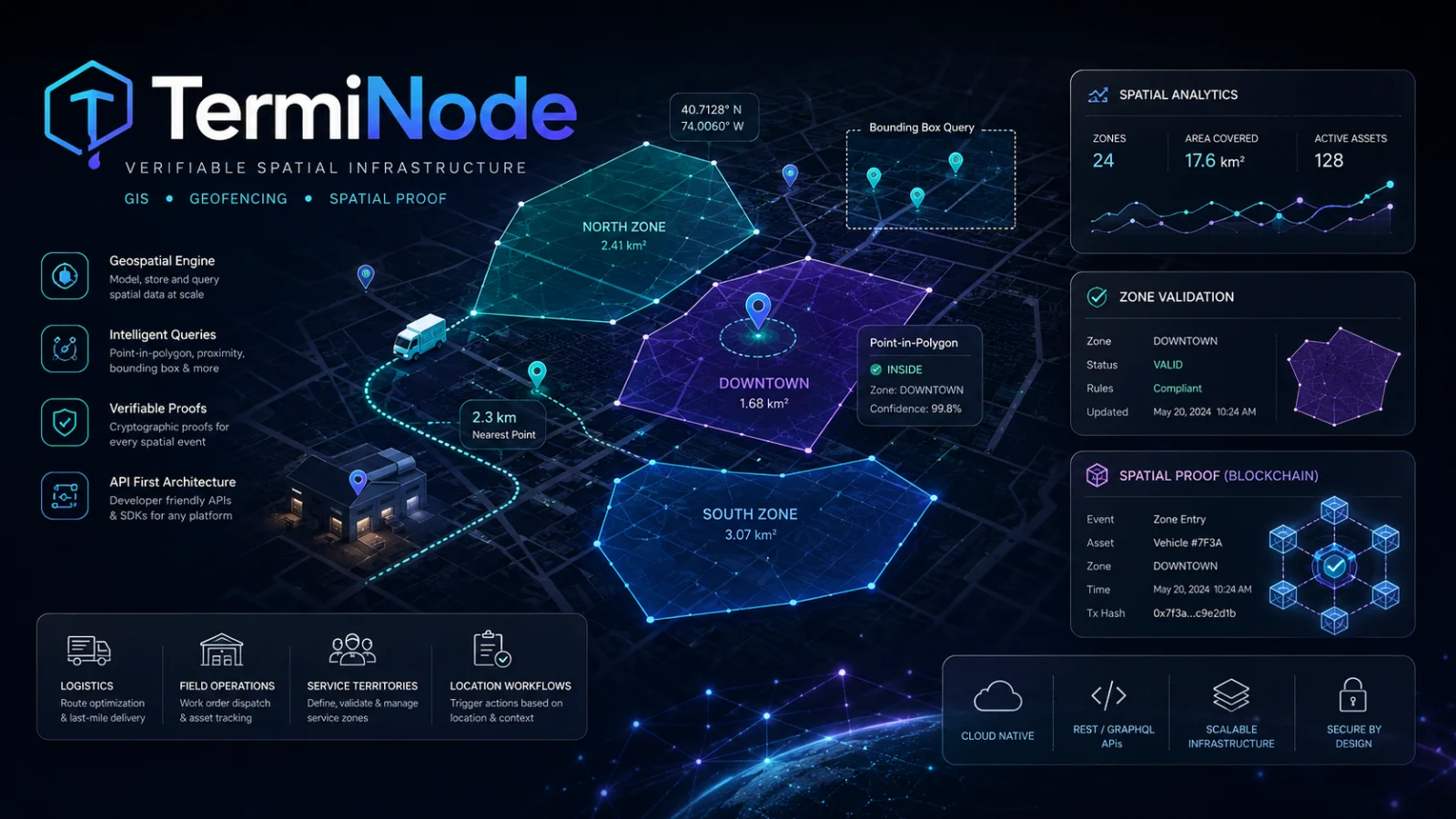
Geofenced attendance workflows can validate employee position
against configured facility or field-work rules.
Payroll Engine
Country-aware payroll rules, attendance summaries, variable earnings,
advances and salary slips are processed through dedicated payroll logic.
Payroll Security
Payroll data uses stricter permission boundaries because salary
and employee financial information require separate authorization.
Role-Based Permissions and Data Isolation
A factory ERP cannot expose every customer, payroll record, financial figure or production action
to every employee. Authorization is therefore part of the domain architecture rather than
an interface-only concern.
Company Scope
Operational records are restricted to the user's permitted organizational context.
Customer Scope
Selected employees can be limited to the customers and accounts they are authorized to manage.
Functional Permissions
Read, create, update, approval, download and sensitive-domain operations can have independent controls.
AI and Model Context Protocol as an ERP Interaction Layer
The application also explores a structured AI interaction model through
Model Context Protocol (MCP). Instead of giving an AI model direct database access,
ERP capabilities are exposed through explicit, permission-aware business tools.
This allows an authorized assistant to reason over ERP information while the application
continues to enforce company scope, customer scope, quantity rules, recipes and business constraints.
Order 360° Analysis
Combine order lines, production, procurement, shipment,
customer stock and operational risks into one contextual view.
Customer 360° Analysis
Bring open orders, reserved stock, production,
procurement and recent shipments together for one customer.
Recipe Explosion
Recursively calculate the raw and semi-finished materials
required to manufacture an order or product quantity.
Procurement Decision Support
Compare supplier options, purchase history, payment terms,
currencies and purchasing rules.
Order Health Scoring
Evaluate due-date pressure, material shortages, missing plans,
procurement gaps and pending production approvals.
Quality Gate Visibility
Read the active production-quality requirements and identify
unresolved checks blocking production completion.
Supplier Scorecards
Analyze lead time, returns, pricing trends, quality and supplier-performance signals.
Margin Analysis
Combine order revenue, product cost and currency information
into structured operational decision support.
The important design principle is that AI does not bypass ERP business rules.
It works through controlled application services, the same way another trusted client
or integration would interact with the ERP.
API-First Integration and Real-Time Infrastructure
A large ERP inevitably becomes an integration platform.
Mobile applications, attendance systems, external services,
AI clients, document workflows and operational dashboards all need controlled access
to the same business state.
REST API & Authentication
- Laravel Passport and Sanctum capabilities
- Explicit API authentication boundaries
- Mobile and integration endpoints
- Idempotency requirements for critical mutations
- Company and permission-aware requests
- Swagger/OpenAPI tooling in the codebase
Queues & Real-Time Events
- Laravel Horizon queue management
- Redis-backed infrastructure capability
- Laravel Reverb real-time communication
- Laravel Echo client integration
- Background document generation
- Asynchronous operational processing
The same architecture principles are used in my
API Integration Services
:
explicit contracts, controlled authorization, idempotency, background processing
and reconciliation instead of fragile direct database coupling.
Architecture: One Operational Backbone, Multiple Domain Workflows
Demand
CRM & Orders
Customers, pricing, order lines, recipes and delivery commitments.
Planning
MRP & Production
Recipe requirements, production plans, work orders, machines and approvals.
Supply
Stock & Procurement
Availability, raw materials, suppliers, arrivals and inventory movement.
Execution
Quality & Logistics
Quality gates, customer stock, warehouse confirmation and shipment.
Intelligence
Finance, Reports & AI
Margin, exposure, KPIs, alerts, MCP and management decision support.
Designed for Transaction Integrity and Operational Traceability
ERP complexity is not primarily a UI problem.
The difficult part is preserving business invariants when several workflows modify related state.
Production approval may alter finished-goods stock, customer-reserved stock,
component quantities and physical material units. Procurement arrival may affect
inventory and customer-linked demand. Shipment approval may affect delivered quantities,
financial exposure and document calculations.
Database Transactions
Related state changes are grouped so partial operational updates do not survive a failed workflow.
Row Locking
Critical concurrent stock and production operations use locking where shared state must remain consistent.
Idempotency
External and AI-assisted mutation flows can require stable request identities to prevent duplicate operations.
Reversal Instead of Deletion
Sensitive stock and production corrections can preserve the original event and record a compensating movement.
Operational Reporting Across Departments
Because sales, inventory, production, procurement and logistics share the same operational model,
reporting can cross departmental boundaries rather than reproducing isolated spreadsheets.
Stock Valuation
Analyze inventory value using operational stock and cost information.
Product Costs
Connect product cost information with recipes, purchasing and operational margins.
Raw-Material Needs
Translate planned or demanded production into material gaps requiring stock or procurement action.
Production Load
Compare planned and produced quantities across dates and production lines.
Shipment Performance
Analyze shipment quantities, customers, dates, returns, costs and delivery results.
Financial Exposure
Review receivables, purchasing cost, logistics cost, exchange-rate movement and estimated margin.
Technical Scope
The codebase reflects the scale of the business workflows it supports.
The application combines traditional ERP screens with asynchronous jobs,
real-time interfaces, document generation, integrations and AI-facing business tools.
PHP 8.5 + Laravel 12
Core domain logic, transactions, APIs, background processing and enterprise workflows.
Livewire 4
Data-intensive operational screens and reactive ERP interfaces.
TailwindCSS + Flowbite
Responsive user interfaces and reusable operational components.
Laravel Horizon + Redis
Queue-oriented processing for expensive and asynchronous workloads.
Laravel Reverb + Echo
Real-time application events and interactive operational communication.
Passport + Sanctum
Authentication foundations for APIs, mobile applications and integrations.
PDF / Excel / CSV Generation
Operational, financial, shipment and commercial document workflows.
QR & Barcode Workflows
Barcode generation and browser-side scanning capabilities for operational processes.
Frappe Gantt + Chart.js
Production planning timelines and data visualization.
Laravel MCP + Laravel AI
Permission-aware AI and structured ERP tool integration.
Google AI / Cloud Integrations
Infrastructure for AI, document, storage, translation and data-oriented integrations.
PWA & Mobile Integration
Support for operational mobile workflows and installable application experiences.
Why This Required a Custom ERP Instead of a Generic Template
The value of this project comes from modeling the factory's actual operational rules.
Packaging quantities, customer-specific recipes, semi-finished products,
physical roll tracking, machine and mold relationships, approval flows,
customer-reserved stock and shipment calculations are tightly connected.
Trying to reproduce these workflows only through generic configuration would either
force the business to change proven operational processes or create a large collection
of disconnected workarounds around the ERP.
The custom approach allowed the software model to follow operational reality while still applying
engineering discipline around permissions, transactional consistency, APIs,
background jobs, auditability and long-term maintainability.
More Than an ERP Dashboard: A Manufacturing Operating System
This project represents one of the most comprehensive examples of my manufacturing software work.
It combines CRM, ERP, MRP-style material planning, production execution,
inventory control, procurement, logistics, quality, finance, HR,
reporting and integration architecture in one continuously evolving codebase.
The most important part is not the number of modules.
It is the relationship between them: customer demand can be traced into material requirements;
material shortages into procurement; procurement and stock into production;
production into customer inventory; customer inventory into shipment;
and shipment back into financial and management reporting.
That end-to-end traceability is what turns separate business screens into an ERP.