If you would like to receive a quote for your project or discuss long-term or short-term business opportunities with me, Schedule an Appointment now.

On-time
Tech
Support
By Tuğrul Yıldırım

CRM–ERP Integration Checklist (2026) | Data, Sync & Governance

CRM–ERP Integration Checklist (2026): Data Ownership, Sync Rules, Failure Modes & Observability

Define system-of-record, sync direction, retries, idempotency, and monitoring—so CRM↔ERP integrations stay stable in production.
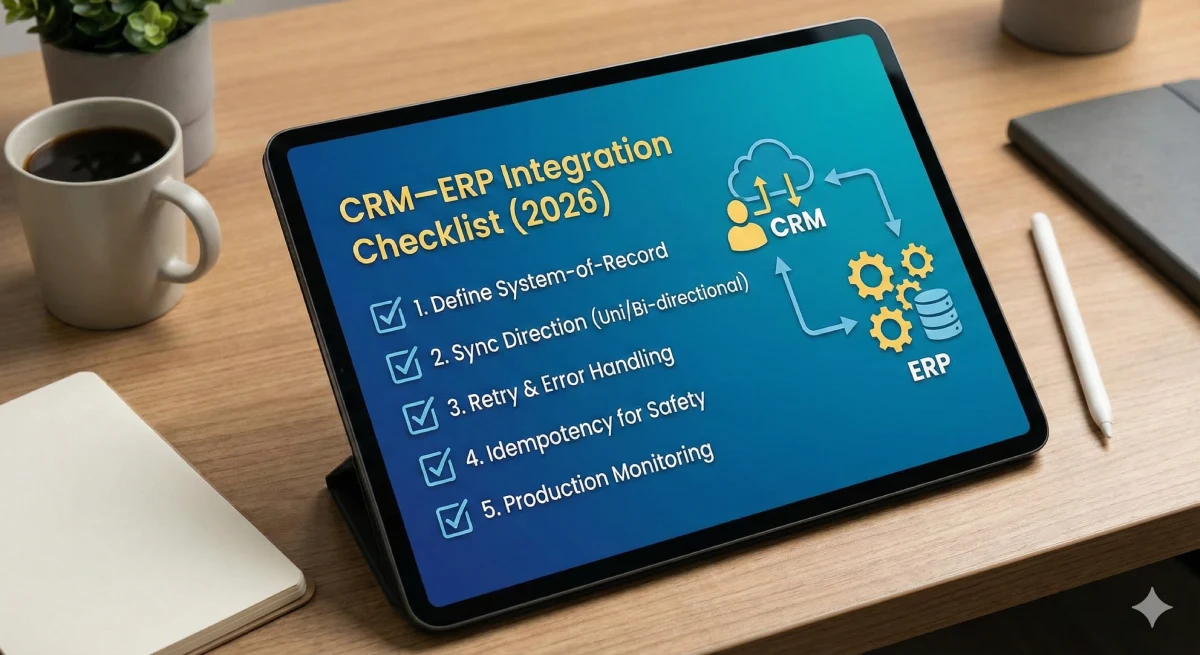
CRM–ERP Integration Checklist (2026) | Data, Sync & Governance

A CRM–ERP integration is not “a connector.” It’s an operating model: clear data ownership, explicit sync rules, and a control plane you can observe and operate. Most teams fail because governance decisions are postponed, then reliability is expected to emerge organically. It won’t.

Checklist

System of Record

“Shared ownership” is the fastest way to create two versions of truth. Define a single system-of-record per entity, and split ownership per field only when the business case is explicit (e.g., ERP owns tax and credit; CRM owns relationship metadata).

Ownership checklist

  • Entity owner: who is authoritative for create/update?
  • Field ownership: define owner per field group (tax, terms, credit, address).
  • ID strategy: stable external IDs and cross-system mapping (no “match by name”).
  • Write policy: approvals, service accounts, and audit requirements.
  • Delete policy: retention, soft-delete, and downstream impact.

Practical decision matrix (example)

Entity System of record Sync direction Governance note
Customer / Account Often ERP ERP → CRM (core), CRM → ERP (controlled fields) Split ownership; conflict rules required.
Contacts CRM CRM → ERP (mirror if needed) Dedup + identity matching is mandatory.
Products / Items ERP ERP → CRM Units, tax, SKU normalization.
Quotes CRM / CPQ CRM → ERP (after approval) Only approved quotes create commitments.
Orders / Invoices ERP CRM → ERP (create), ERP → CRM (status) Finance truth must remain singular.

Architecture

Bi-directional vs one-way

Bi-directional sync is a risk multiplier unless you ship explicit conflict rules, versioning, and replay tooling. Default to one-way where possible; upgrade to bi-directional only when the business impact is measurable.

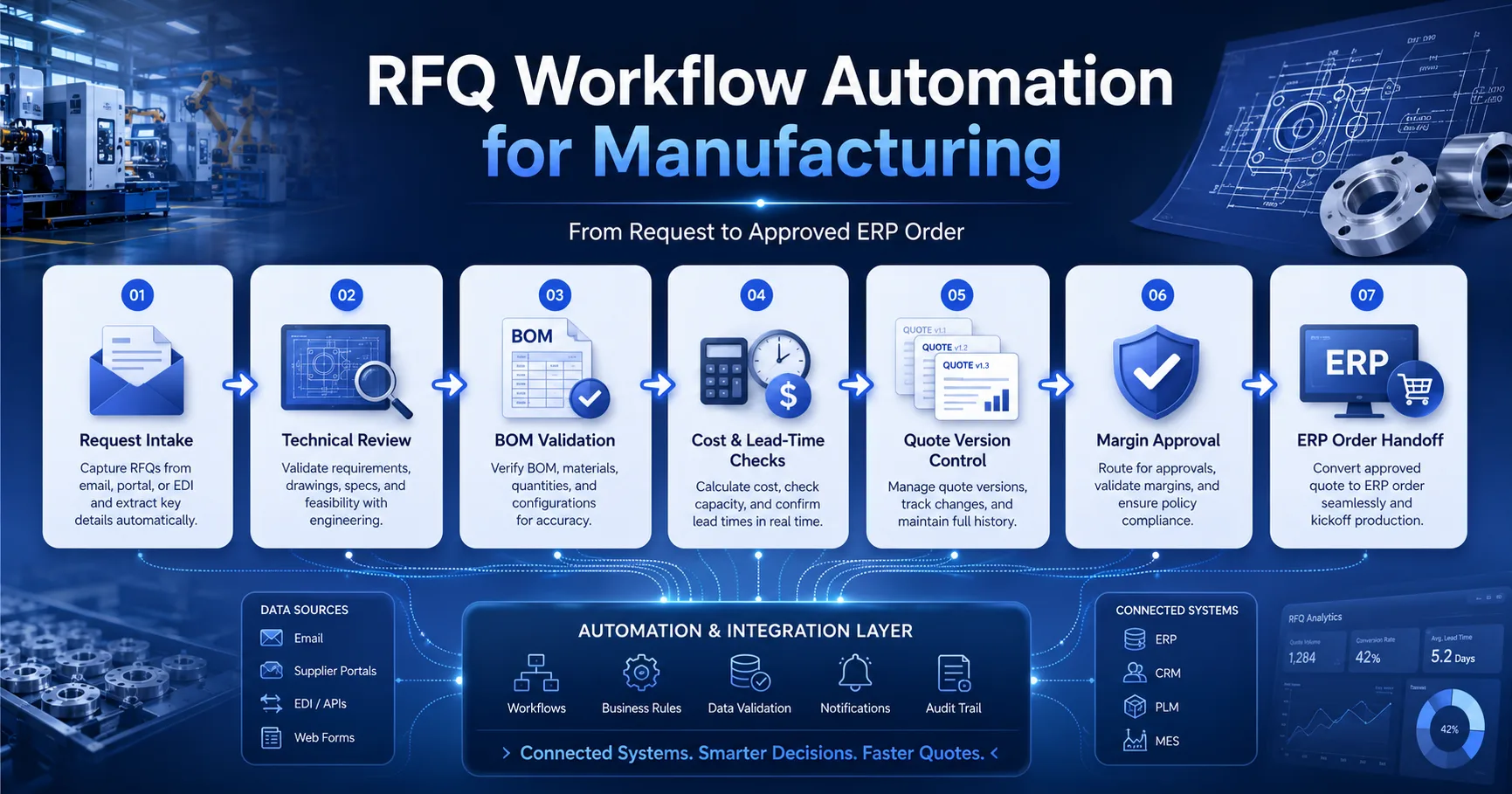
For a commercial-first architecture lens (RFQ → Quote → Approval → Order → Invoice), align your integration model with the Quote-to-Cash motion: Quote-to-Cash Blueprint.


Contract

Mapping rules

Mapping is a contract: transformations, validation, enums, currency, tax logic, time zones, rounding, and lifecycle semantics. If you don’t formalize the spec, you will create silent drift and “unreconciled truth.”

Mapping spec must include

  • Canonical schema: versioned payloads
  • Normalization: units/codes/decimals
  • Enum governance: status/tax/discount
  • Validation: fail fast with actionable errors
  • Deprecation: compatibility windows

Non-negotiables in 2026

  • Stable IDs across systems
  • Idempotency keys on every write path
  • Correlation IDs end-to-end propagation
  • Contract tests for payload versions
  • Strict error semantics (422/409 vs retry)

Mapping template (operator-friendly)

Field Source Transform Validation Target Error semantics
customer.external_id ERP String normalize Required, unique CRM.account.external_id 409 duplicate; 422 invalid
price.currency ERP/CPQ ISO-4217 Allowed set CRM.quote.currency 422 unknown
order.status ERP Enum map Known states only CRM.order_view.status 500 unmapped (contract breach)

Reliability

Failure modes

Integrations fail in predictable categories. Your job is to classify, design recovery, and make failure visible early. Reliability is a product requirement—treat it like one.

Failure type Typical cause Design response Operator action
Transient Timeouts, 5xx, rate limits Retries w/ backoff + jitter, circuit breaker Validate downstream health
Permanent validation Bad payload, enum mismatch Fail-fast 422/409, DLQ Fix mapping/spec; replay
Duplicate delivery Webhook retries, queue redelivery Idempotent handlers, dedup by event_id No manual action (safe by design)
Out-of-order Parallel workers, delays Version checks, watermarks Run reconciliation job
Silent drift Missed updates, mapping divergence Reconciliation SLIs, checksums Backfill + root cause fix

Ship these primitives by default

Idempotency

Every write path must tolerate duplicate delivery without side effects.

Retry policy

Backoff + jitter, stop conditions, and rate-limit handling.

DLQ + Replay

Deterministic replay tooling; no “manual DB patch” operations.

Runbooks

Triage → replay → verify steps documented for operators.


Control

Reconciliation

Reconciliation is your control system against drift. Even in event-driven setups, you need scheduled verification because migrations, humans, and edge cases exist.

Reconciliation checklist

  • Daily drift report: missing references, failed writes, freshness lag.
  • Checksums: hash critical fields to detect changes without full compares.
  • Backfills: replay windows (7/30 days) with idempotent writes.
  • Exception routing: assign deltas to data owners (RevOps/Finance/Inventory).
  • Audit trail: actor, intent, payload fingerprint, outcome.

Observability

Monitoring & SLO

Run integrations like a service. “Server is up” is not a success metric. You need SLIs for lag, success rate, replay volume, and drift—then alert against SLO burn, not noise.

Core SLIs

  • Success rate (no manual intervention)
  • End-to-end latency (p95)
  • Queue lag/backlog (oldest message age)
  • DLQ volume + replay success
  • Drift rate (reconciliation failures)

Minimum observability

  • Correlation IDs across HTTP → queue → worker → DB
  • Structured logs with entity + tenant context
  • Dashboards for lag/errors/DLQ/drift
  • Alerts tied to SLO burn-rate

Governance

Security & RBAC

CRM–ERP integration is a privileged corridor. Design a security boundary, then enforce it: least privilege service identities, scoped tokens, audited writes, and signed webhooks.

Security checklist

  • Service identities: separate accounts per domain (orders, customers, inventory).
  • Scoped tokens: rotate secrets; avoid long-lived static keys.
  • RBAC gates: approvals for pricing overrides and credit/terms changes.
  • Audit logs: actor, payload fingerprint, outcome for all critical writes.
  • Webhook security: signed payloads, replay protection, allowlists where applicable.

Delivery

Go-live checklist

Go-live is an operational transition. Ensure controlled rollout, rollback posture, and day-one visibility. Below is a pragmatic launch sequence you can actually operate.

  1. Pre-go-live: contracts & governance

    • System-of-record sign-off per entity/field.
    • Mapping spec complete; error semantics agreed.
    • Idempotency and dedup verified with forced retries.
    • Security review: scopes, rotation, RBAC, auditing.
  2. Pre-go-live: testing

    • Golden-path tests (lead → quote → approval → order → invoice signals).
    • Chaos tests (timeouts, 5xx, out-of-order events, DLQ).
    • Load/throughput validation and downstream constraints.
  3. Launch: controlled rollout

    • Staged rollout to a subset of accounts/teams.
    • Feature flags to pause writes while keeping reads alive.
    • War-room dashboards: success rate, lag, DLQ, drift.
  4. Post-go-live: stabilization

    • Daily reconciliation for 2–4 weeks.
    • Baseline SLOs; tune thresholds based on real p95.
    • Contract governance: version reviews + deprecation policy.

FAQ

FAQ

Need to harden your CRM↔ERP integration?

Get a scoped plan: ownership rules, contracts, failure design, and observability—aligned to Quote-to-Cash outcomes.

Share this article

Related Articles

Continue reading with these related articles on CRM, ERP, and API integrations.

Need help implementing these insights?

Get a practical scope direction and integration roadmap for your CRM, ERP, or API project.

Typical response within 24 hours · Clear scope & timeline · Documentation included