iPaaS vs Custom Integration Layer | CRM/ERP Decision Framework
iPaaS vs Custom Integration Layer
Choose iPaaS or a custom integration layer using a clear decision matrix: TCO, latency, governance, compliance, and maintainability.
If you would like to receive a quote for your project or discuss long-term or short-term business opportunities with me, Schedule an Appointment now.
iPaaS vs Custom Integration Layer
Choose iPaaS or a custom integration layer using a clear decision matrix: TCO, latency, governance, compliance, and maintainability.
Executive brief
iPaaS vs custom integration is not a tooling debate—it’s a commercial decision. The wrong choice shows up later as broken orders, delayed invoices, audit gaps, or vendor lock-in.
For implementation standards (versioned contracts, signing, idempotency, governance), anchor decisions to /api-integrations. For end-to-end CRM↔ERP workflow context, see /crm-erp-integration.
If you need a CRM ERP integration platform that delivers fast—and your use cases align with common connector patterns—iPaaS is a pragmatic accelerator. In enterprise terms, it can reduce time-to-value and front-load predictable governance through a managed runtime.
Long-tail keyword angle: teams searching for “iPaaS pricing vs custom integration cost” are usually already scaling. If your roadmap includes high-frequency order events or real-time inventory, evaluate iPaaS unit economics early—before you lock in.
A custom integration layer is an internal product: it standardizes contracts, enforces governance, and makes CRM↔ERP flows operationally reliable. It typically pays off when integrations are core to revenue, compliance, or operational SLAs.
| Requirement | Why it pushes you to custom | Practical governance outcome |
|---|---|---|
| Strict compliance / data residency | You need full control over where data lives and how it’s logged. | Deterministic retention + audit-grade traces + least-privilege controls. |
| High throughput / low latency | Unit costs and latency become a product feature. | Queue-backed processing, idempotency, and performance SLOs. |
| Complex domain logic | ERP rules (tax, inventory, approval chains) don’t fit generic flows. | Domain services + contract versioning with migration guides. |
| Advanced observability | You need end-to-end visibility across CRM, ERP, and middleware. | Unified correlation IDs, structured logs, traces, and replay. |
If you build custom, treat it as a platform: versioned contracts, standardized errors, webhook signing, idempotency rules, and change governance. Use /api-integrations as the baseline for contract discipline.
In practice, enterprises rarely pick a single tool forever. A hybrid approach reduces risk: use iPaaS where it’s commodity and build custom where it’s strategic.
Marketing tools, basic syncs, and low-risk connectors that benefit from speed.
iPaaS-friendlyOrders, invoicing, inventory, returns—where correctness and auditability are non-negotiable.
Custom layerOne contract policy, one error standard, one observability model—regardless of where logic runs.
Enterprise defaultA clean hybrid design uses clear boundaries: iPaaS triggers events, custom layer owns business-grade contracts, and the CRM–ERP system-of-record rules are defined in one place. For the workflow view, see /crm-erp-integration.
The right decision emerges when you model total cost of ownership—not just “how fast can we integrate.” A credible TCO includes engineering time, platform fees, incident costs, compliance overhead, and migration risk.
| Cost component | iPaaS profile | Custom layer profile | Decision signal |
|---|---|---|---|
| Initial build | Low–medium | Medium–high | Speed vs strategic control |
| Run costs | Subscription + usage | Infra + ops | Unit economics at scale |
| Change costs | Fast if supported by platform | Fast if governance is mature | Contract discipline matters |
| Incident costs | Can be opaque (vendor boundary) | Transparent (full visibility) | MTTR and audit readiness |
| Lock-in / migration | Higher risk | Lower risk | Exit strategy required |
iPaaS
Custom layer
Compliance is the most common “late-stage blocker” in integration programs. Define the control framework early: data residency, auditability, encryption, RBAC, and incident evidence. The more regulated your industry, the more custom becomes attractive.
If your governance standard includes signed webhooks, versioned contracts, and idempotency, align controls with /api-integrations.
Observability is where many iPaaS vs custom decisions become obvious. In mature CRM–ERP operations, teams need consistent correlation IDs, structured logs, traceability across hops, and a repeatable replay strategy.
Make “debuggability” a first-class requirement. If the business asks “why is the invoice missing?”, you should answer in minutes—not days—without tribal knowledge.
Tie every transaction to a correlation ID and expose it in UI, logs, and support tickets. This single move can cut incident resolution time dramatically.
The best CRM ERP integration platform decisions include an exit strategy. Whether you start with iPaaS and move to custom, or consolidate custom logic after M&A, plan migrations as controlled phases—not rewrites.
Define versioned payloads, error envelopes, and mapping rules (system-of-record).
Route requests through a controlled boundary to enforce signing, idempotency, and policy.
Start with high-impact workflows (orders/returns) and measure SLO improvements.
Keep parallel run, validate reconciliation, then sunset old routes with clear comms.
If you’re planning a hybrid or migration, start with contract and governance baselines on /api-integrations and validate CRM↔ERP boundaries using /crm-erp-integration.
I can deliver a tailored decision matrix (TCO + compliance + observability) for your CRM/ERP landscape, including a phased roadmap that minimizes operational risk.
Continue reading with these related articles on CRM, ERP, and API integrations.
Integration Observability for CRM/ERP
How to make integrations debuggable: correlation IDs, structured logs, metrics, tracing, alerting, and SLOs—so failures...
Read more
Change Data Capture for CRM–ERP Integrations
A practical blueprint to choose CDC, webhooks, or polling for CRM–ERP sync—latency, reliability, data correctness, and o...
Read more
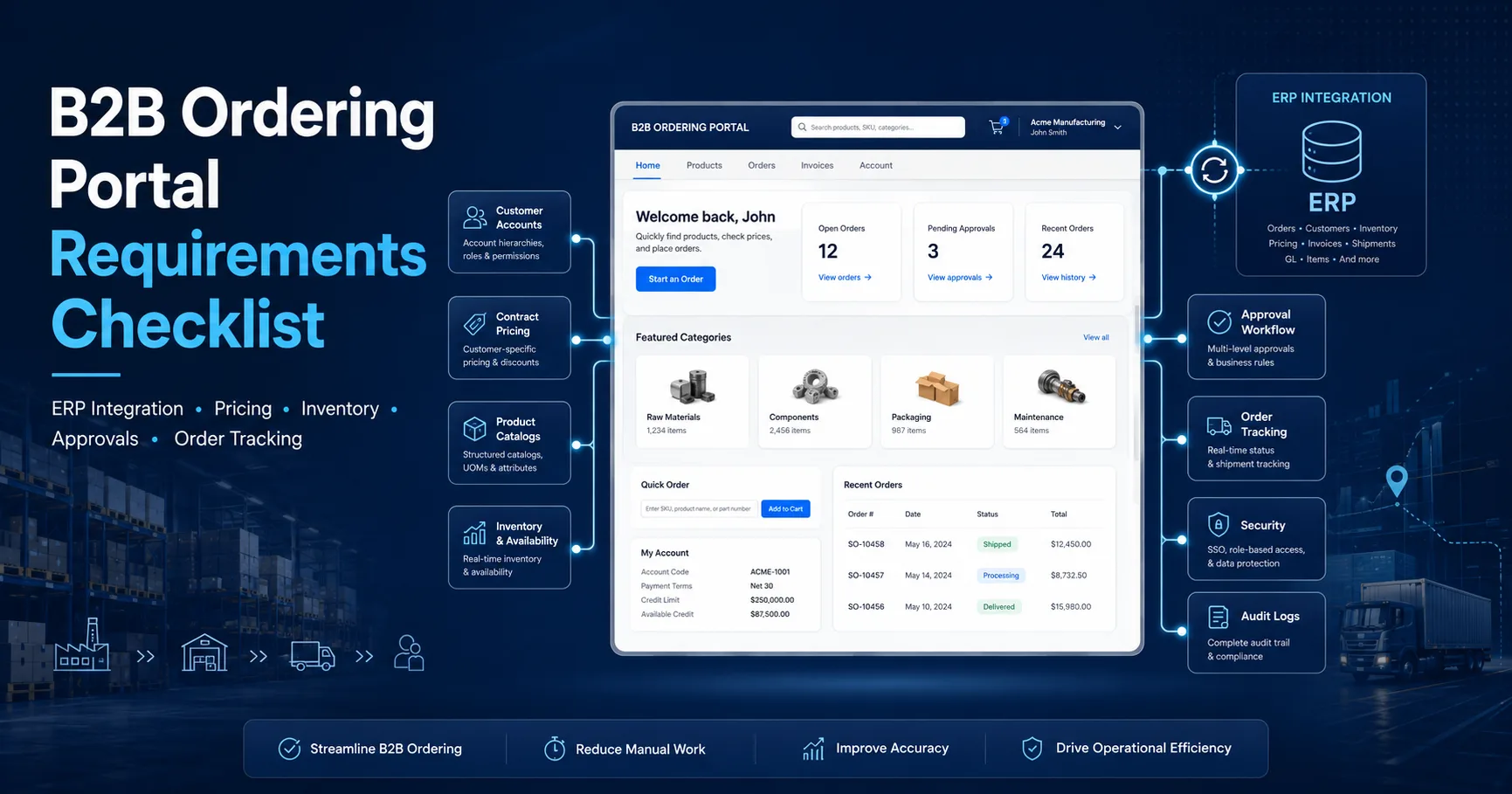
B2B Order Portal + ERP Integration
A blueprint to connect self-service ordering with ERP: contract pricing sync, ATP availability, order status, invoices,...
Read moreGet a practical scope direction and integration roadmap for your CRM, ERP, or API project.
Typical response within 24 hours · Clear scope & timeline · Documentation included